
A good greenhouse fan layout should promote even airflow, prevent stagnant spots, and maintain consistent temperatures and humidity levels. You want to position exhaust fans near the roof and intake vents lower down to leverage natural convection. Spacing fans evenly helps avoid circular airflow and trapped air. Adjusting angles and adding circulation fans can reach hard-to-access areas. If you keep optimizing your setup, you’ll create a healthier environment for your plants and save energy—learn more to perfect your system.

Get garden gear delivered free with Prime
- Fast, free delivery on millions of items
- Prime Video, Amazon Music and more included
- Member-only deals all year
Key Takeaways
- Promote uniform airflow to prevent temperature and humidity fluctuations throughout the greenhouse.
- Effectively remove heat, excess moisture, and stagnant air from all zones.
- Optimize fan placement to maximize ventilation efficiency and energy savings.
- Minimize dead zones and ensure even air distribution in all greenhouse areas.
- Support healthy plant growth by maintaining consistent environmental conditions.

Have you ever wondered how to enhance airflow in your greenhouse? Achieving the right ventilation efficiency isn’t just about installing fans randomly; it’s about creating effective airflow patterns that keep your plants healthy and your environment stable. A good greenhouse fan layout ensures air moves smoothly throughout the space, preventing pockets of stagnant air and temperature inconsistencies. When properly designed, your fan system promotes uniform temperature distribution, humidity control, and even CO₂ levels, which are crucial for ideal plant growth.
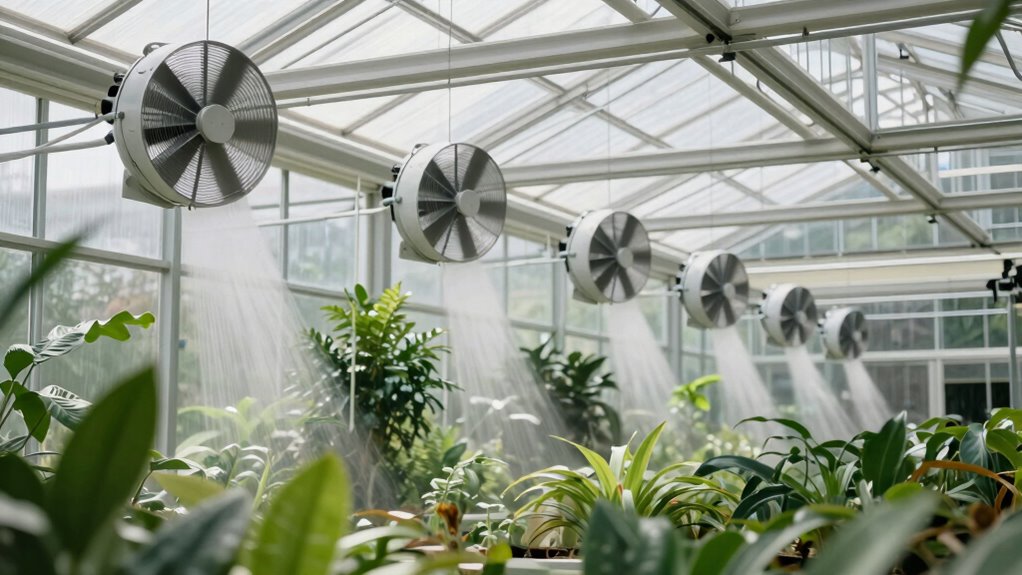
To start, consider positioning your fans to encourage circulation rather than just directed airflow. For instance, installing exhaust fans near the roof and intake vents lower down creates a natural airflow pattern. This setup pulls cooler, fresh air in at the bottom and pushes warmer, stale air out at the top. Such a layout enhances ventilation efficiency because it leverages natural convection, reducing the workload on your fans and saving energy. It’s important that the fans are spaced evenly and strategically, so air doesn’t just move in circles or get trapped in corners, but instead circulates throughout the entire greenhouse. Understanding ventilation efficiency can help you optimize fan placement to maximize airflow and energy savings.
Position exhaust fans at the roof and intake vents lower down for natural, efficient airflow.
Your fan layout should also account for the size and shape of your greenhouse. Large or elongated structures require multiple fans positioned along the length to promote consistent airflow. In narrower greenhouses, a fan at each end can help establish a continuous airflow pattern that prevents temperature stratification. The goal is to create a gentle, steady breeze that encourages air exchange without causing stress to your plants. This steady airflow helps disperse heat, humidity, and any airborne pests or spores, contributing to a healthier growing environment. Additionally, understanding airflow patterns can guide you in creating a balanced ventilation system that adapts to changing weather conditions. Recognizing dead zones and their causes helps in designing a more efficient system that minimizes stagnant air pockets.
Another key aspect is avoiding dead zones—areas where airflow stagnates. You can do this by adjusting fan angles or adding circulation fans in corners and hard-to-reach spots. These smaller fans help distribute air evenly, preventing hot or humid pockets that could foster disease or inhibit growth. Regularly monitoring airflow patterns with an anemometer or visual cues, like moving dust or leaves, guides you in fine-tuning your layout. Incorporating airflow visualization techniques can further improve your understanding of how air moves within your greenhouse and help identify areas needing adjustment. Properly managing these airflow dynamics ensures your greenhouse environment remains stable and healthy for your plants.
In the end, a well-planned greenhouse fan layout isn’t just about having fans in place; it’s about designing a system that actively promotes ideal airflow patterns and maximizes ventilation efficiency. When you invest time in setting up a strategic arrangement, you’ll see improved plant health, reduced energy costs, and a more stable environment overall. Proper airflow is the backbone of a productive greenhouse, and your layout determines just how well that backbone functions.
As an affiliate, we earn on qualifying purchases.
Frequently Asked Questions
How Do Fan Placement Impacts Humidity Control?
Fan placement directly influences humidity control by optimizing air circulation and airflow patterns. When you position fans strategically, you guarantee even distribution of air, preventing pockets of humid or dry zones. Proper placement helps break up stagnant air, reducing excess moisture buildup that can lead to mold or disease. By managing airflow effectively, you maintain stable humidity levels, creating a healthier environment for your plants and improving overall greenhouse efficiency.
What Fan Speed Settings Are Most Effective?
You should set your greenhouse fans to a moderate speed for ideal humidity control, balancing airflow without causing excessive fan noise. Higher speeds quickly reduce humidity but may waste energy and create loud noise, which can disturb plants and workers. Lower speeds are more energy-efficient and quieter but might not circulate air effectively. Adjust fan speeds based on your greenhouse’s humidity levels, ensuring proper ventilation without sacrificing energy efficiency or increasing noise.
How Often Should Greenhouse Fans Be Maintained?
You should maintain your greenhouse fans at least quarterly to guarantee ideal ventilation efficiency and keep fan energy consumption in check. Regular upkeep, like cleaning blades and inspecting motors, prevents dust buildup and mechanical issues. Juxtapose the quiet operation of well-maintained fans with the noise and inefficiency of neglected ones, emphasizing that consistent maintenance not only prolongs fan lifespan but also sustains healthy plant growth.
Can Fans Help With Pest Prevention?
Yes, fans can help with pest prevention by improving air circulation in your greenhouse. Good airflow disrupts pest migration, making it harder for pests to settle and thrive. When fans keep the air moving, it creates an environment less attractive to pests and reduces humidity levels that pests favor. Regularly using fans can be an effective, natural way to minimize pest problems and maintain healthier plants.
Do Different Crops Require Different Fan Layouts?
Yes, different crops require different fan layouts because crop-specific airflow is crucial for ideal growth. You should consider fan type considerations, such as size, placement, and direction, to guarantee even distribution of air tailored to each crop’s needs. Adjusting fan positioning helps prevent issues like mold, pests, or uneven temperature, making your greenhouse more efficient and healthier for diverse plants.
Conclusion
A well-designed greenhouse fan layout isn’t just about placement — it’s about creating ideal airflow that boosts plant health and energy efficiency. Did you know that proper ventilation can increase crop yields by up to 30%? By strategically positioning your fans, you guarantee consistent temperature and humidity, reducing disease risk and promoting vigorous growth. Remember, a smart layout actively works with your greenhouse’s unique needs, transforming it into a thriving, productive environment.
Fall yard work Picks
leaf blowers
As an affiliate, we earn on qualifying purchases.