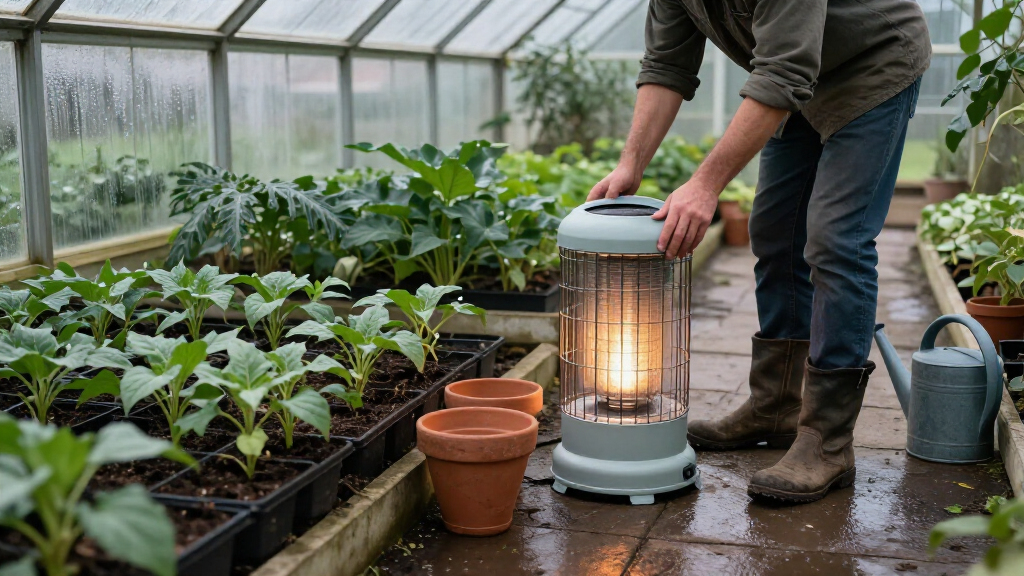

For most growers, I’d start with the Bio Green PALMA, which combines heating, air circulation, and a digital thermostat in a purpose-built greenhouse unit. The VIVOSUN AeroFlux 700W stands out for lower-wattage, app-connected grow spaces, while the Pasapair WiFi heater suits shoppers who want remote control with 1500W output. The main tradeoff is between powerful, straightforward heaters and more specialized models with tighter control or smart features. Your greenhouse size, insulation, local winter lows, and available electrical circuit matter as much as the heater’s wattage. Read on for my full comparison of all 15 options and guidance on matching a heater to your setup.

Get garden gear delivered free with Prime
- Fast, free delivery on millions of items
- Prime Video, Amazon Music and more included
- Member-only deals all year
Complete the kit


Key Takeaways
- Purpose-built controls separate the strongest greenhouse choices: the Bio Green PALMA pairs a digital thermostat with a fan, while many portable options focus on basic heat and airflow.
- Lower wattage can be a better fit for a small grow space: the VIVOSUN AeroFlux is rated at 700W and adds app control and VPD monitoring, but it is not a like-for-like substitute for a 1500W heater in a larger, colder greenhouse.
- WiFi features are useful for remote oversight, not a cure for poor insulation: Pasapair and lesotc add connected control, but greenhouse heat loss still determines whether their output can maintain the target temperature.
- Many models share a 1500W rating, so wattage alone does not distinguish them: thermostat design, intended use, portability, and documented safety protections help narrow the field.
- Space-heater versatility comes with a fit tradeoff: models such as the Air Choice and ORAVIONA may suit small spaces, while greenhouse-specific units are a more direct match for regular growing use.
| SEEYANG Greenhouse Heater with Digital Thermostat, 1500W |  | Best for Medium-Sized Greenhouses | Heating output: 1500W | Heating method: Radiant | Recommended coverage: Up to 200 sq ft | VIEW LATEST PRICE | See Our Full Breakdown |
| VIVOSUN AeroFlux 700W PTC Grow Tent Heater with Thermostat, App Control, and VPD Monitoring |  | Best Smart Pick for Grow Tents | Heating power: 700W | Heating method: PTC | Heat levels: 5 | VIEW LATEST PRICE | See Our Full Breakdown |
| TRUSTECH 1500W Greenhouse Heater with Digital Thermostat |  | Best for Adjustable Heat Levels | Heating power: 750W or 1500W | Heating method: PTC ceramic | Modes: Low heat, high heat, fan only | VIEW LATEST PRICE | See Our Full Breakdown |
| Bio Green PALMA Electric Greenhouse Heater and Fan with Digital Thermostat |  | Best for Damp Greenhouse Conditions | Power settings: 750W or 1500W | Heat output: 5118 BTU/hour | Thermostat range: 32°F–185°F | VIEW LATEST PRICE | See Our Full Breakdown |
| Air Choice 1500W Portable Ceramic Space Heater |  | Best Portable Greenhouse Heater | Heating element: PTC ceramic | Power: 1500W | Modes: Low, High, Fan-Only | VIEW LATEST PRICE | See Our Full Breakdown |
| VEVOR 1500W Electric Greenhouse Heater with Fan |  | Best for Adjustable Airflow | Power: 1500 watts | Heating method: Forced air | Modes: Low heat, high heat, and fan | VIEW LATEST PRICE | See Our Full Breakdown |
| VEVOR 1500W Greenhouse Heater with Thermostat and Fan |  | Best for Basic Thermostat Control | Power: 1500W | Heating modes: Low and high | Fan mode: Yes | VIEW LATEST PRICE | See Our Full Breakdown |
| Fanspex 1500W Portable Heater with Digital Thermostat |  | Best for Timed, Hands-Off Heating | Power: 1500 watts | Heating element: PTC ceramic | Heating coverage: Up to 120 square feet | VIEW LATEST PRICE | See Our Full Breakdown |
| Pasapair 1500W WiFi Greenhouse Heater with Thermostat |  | Best Smart-Control Pick | Heating method: PTC ceramic | Power: 1500 watts | Heating coverage: 215 square feet | VIEW LATEST PRICE | See Our Full Breakdown |
| VEVOR 1500W Portable Greenhouse Heater with Fan |  | Best for Larger Listed Coverage | Power: 1500 W | Heat output: 5100 BTU | Heating coverage: 150–200 sq ft | VIEW LATEST PRICE | See Our Full Breakdown |
| SmterCon Greenhouse Heater with Thermostat |  | Best for Automatic Temperature Control | Power: 1500 W | Coverage: Up to 120 sq. ft. | Thermostat: Digital, automatic temperature control | VIEW LATEST PRICE | See Our Full Breakdown |
| VEVOR 1500W Greenhouse Heater with Thermostat |  | Best for Adjustable Heating and Ventilation | Power: 1500 W | Heating output: 6800 BTU | Speeds: 3 | VIEW LATEST PRICE | See Our Full Breakdown |
| Roodike 1500W Blower Heater with Thermostat |  | Best for Lower-Power Supplemental Heat | Heating power: 1500 W | Low heat setting: 750 W | Modes: High heat, low heat, natural wind | VIEW LATEST PRICE | See Our Full Breakdown |
| lesotc Smart Greenhouse Heater, 1500W with WiFi Thermostat |  | Best Smart Greenhouse Heater | Heating power: 1500 W | Coverage: Up to 150 sq. ft. | Heating element: PTC ceramic | VIEW LATEST PRICE | See Our Full Breakdown |
| ORAVIONA 1500W PTC Ceramic Space Heater with Overheat Protection |  | Best for Adjustable Airflow Direction | Power settings: 25 W fan-only; 750 W low heat; 1500 W high heat | Heating element: PTC ceramic | Heating method: Forced air | VIEW LATEST PRICE | See Our Full Breakdown |
| greenhouse heater | Modes | Power |
|---|---|---|
| SEEYANG Greenhouse Heater with | — | — |
| VIVOSUN AeroFlux 700W PTC Grow | — | — |
| TRUSTECH 1500W Greenhouse Heat | Low heat, high heat, fan only | — |
| Bio Green PALMA Electric Green | — | — |
| Air Choice 1500W Portable Cera | Low, High, Fan-Only | 1500W |
| VEVOR 1500W Electric Greenhous | Low heat, high heat, and fan | 1500 watts |
| VEVOR 1500W Greenhouse Heater | — | 1500W |
| Fanspex 1500W Portable Heater | High heat, low heat, fan only | 1500 watts |
| Pasapair 1500W WiFi Greenhouse | ECO, Fan Only, Low, High | 1500 watts |
| VEVOR 1500W Portable Greenhous | Heating and ventilation | 1500 W |
| SmterCon Greenhouse Heater wit | — | 1500 W |
| VEVOR 1500W Greenhouse Heater | Heating and ventilation | 1500 W |
| Roodike 1500W Blower Heater wi | High heat, low heat, natural wind | — |
| lesotc Smart Greenhouse Heater | — | — |
| ORAVIONA 1500W PTC Ceramic Spa | — | — |
More Details on Our Top Picks
SEEYANG Greenhouse Heater with Digital Thermostat, 1500W
The SEEYANG is a practical fit for growers who need thermostat-controlled heat across a stated area of up to 200 square feet. Its digital control range of 40°F to 108°F gives more room to set a target than the Bio Green PALMA’s stated lower limit of 32°F but narrower coverage of up to 120 square feet. A separate 25W fan mode can move air without running the heater, useful when warmth is not needed. The stainless steel shell and overheat protection add relevant greenhouse safeguards, though the product data does not give a splash-resistance rating. This is a floor-mounted, outlet-dependent heater, not a cordless or wall-mounted solution; its 1500W output may also fall short in larger or poorly insulated structures.
Pros:- Digital thermostat adjusts from 40°F to 108°F
- Rated for greenhouse spaces up to 200 square feet
- 25W fan mode circulates air without full heating
- Stainless steel shell and automatic overheat protection
Cons:- Coverage is limited to spaces up to 200 square feet
- Requires a nearby electrical outlet
- No splash-resistance rating is specified
Best for: Greenhouse owners with an electrical outlet and a space near or below 200 square feet who want a digital thermostat and a separate air-circulation mode.
Not ideal for: Owners of larger greenhouses or buyers who need a heater with a stated splash-protection rating, since the coverage is limited and no ingress rating is listed.
- Heating output:1500W
- Heating method:Radiant
- Recommended coverage:Up to 200 sq ft
- Temperature range:40°F–108°F
- Fan mode:25W
- Mounting type:Floor mount
- Overheat protection:Yes
- Power cord length:7.5 ft
Our verdict“Choose the SEEYANG for thermostat-managed heat in a medium-sized greenhouse, but look elsewhere for larger coverage or a stated splash rating.”
VIVOSUN AeroFlux 700W PTC Grow Tent Heater with Thermostat, App Control, and VPD Monitoring
The AeroFlux takes a different approach from the 1500W greenhouse heaters here: its 700W output and tabletop footprint suit a compact grow tent where app scheduling and sensor data matter more than broad coverage. It offers five heat levels, temperature control, and VPD monitoring, plus day-and-night scheduling through the app. That makes it more adjustable for growers managing a contained environment than the simpler SEEYANG, which has a digital thermostat but no listed app controls or VPD tracking. The tradeoff is scale: the product is described for grow tents, with no square-foot coverage figure provided, so I would not treat it as a general greenhouse heater for a larger structure. App connectivity also adds setup requirements, while tip-over and overheat shutoff address basic operating risks.
Pros:- App controls support scheduling and day-and-night modes
- Sensor tracks temperature and VPD
- Five heat levels offer finer adjustment than basic low/high controls
- Tip-over protection and overheat shutoff are included
Cons:- 700W output is aimed at compact grow spaces rather than broad greenhouse coverage
- No recommended square-foot coverage is listed
- App functions may require setup and a network connection
Best for: Indoor growers managing a compact tent who want app scheduling and temperature and VPD information alongside adjustable heat.
Not ideal for: Greenhouse owners heating a broad area or buyers who prefer a simple standalone heater, since output is 700W and app functions require setup and connectivity.
- Heating power:700W
- Heating method:PTC
- Heat levels:5
- Maximum temperature setting:30°C
- Controls:Local controls and app
- Mounting type:Tabletop
- Safety features:V0 flame-retardant materials, tip-over protection, overheat shutoff
- Dimensions:9.45 × 4.72 × 9.45 in (D × W × H)
Our verdict“Pick the AeroFlux for a connected grow tent with environmental monitoring, not for heating a larger greenhouse.”
TRUSTECH 1500W Greenhouse Heater with Digital Thermostat
The TRUSTECH gives growers a useful middle ground between a fixed-output heater and the connected VIVOSUN AeroFlux: it offers 750W and 1500W heat settings, plus fan-only operation, without relying on app controls. Its PTC ceramic element is listed as warming in about three seconds, while the digital thermostat spans 40°F to 108°F and uses a waterproof sensor probe. The stated 160-square-foot coverage is less than the SEEYANG’s 200 square feet, so it better suits a smaller greenhouse or grow area. A 90-degree adjustable tilt and portable handle make it easier to direct or reposition heat, but that convenience does not expand its coverage. It needs an outlet, and the listed safety protections do not replace careful placement around moisture and plants.
Pros:- 750W and 1500W settings let growers moderate heat output
- Digital thermostat spans 40°F to 108°F with a waterproof sensor probe
- Fan-only mode circulates air without heating
- Portable design includes a handle, non-slip base, and 90-degree tilt
Cons:- Rated coverage is lower than the SEEYANG at up to 160 square feet
- Requires an electrical outlet
- No app control or greenhouse splash-protection rating is listed
Best for: Growers with a greenhouse or grow area up to about 160 square feet who want two heat levels, a thermostat, and portable directional placement.
Not ideal for: Owners of spaces larger than the stated coverage or buyers seeking app scheduling, since this model has no listed connected controls.
- Heating power:750W or 1500W
- Heating method:PTC ceramic
- Modes:Low heat, high heat, fan only
- Coverage:Up to 160 sq ft
- Thermostat range:40°F–108°F (5°C–42°C)
- Voltage:120V
- Tilt:90° adjustable
- Cord length:7.5 ft
Our verdict“Choose the TRUSTECH when adjustable output and portable aiming matter more than the SEEYANG’s broader stated coverage or the VIVOSUN’s app features.”
Bio Green PALMA Electric Greenhouse Heater and Fan with Digital Thermostat
The PALMA stands apart from the portable heaters in this group through its IPX4 splash protection, a useful distinction for greenhouse settings where water may be present. It pairs that protection with 750W or 1500W heat, an automatic thermostat, and a fan capable of circulating up to 5800 cubic feet of air per hour. Compared with the SEEYANG, it covers less area—up to 120 square feet—but its listed temperature range starts lower, at 32°F, and extends to 185°F. That broad control range and independent air-circulation mode may suit growers who want one unit for temperature management and airflow. The limits are substantial: it is designed for a smaller area and calls for a 120V, 15A supply, so buyers should check their circuit before choosing it.
Pros:- IPX4 splash-proof rating suits damp greenhouse environments
- Two heat settings provide 750W or 1500W output
- Fan mode circulates up to 5800 cubic feet of air per hour
- Thermostat range spans 32°F to 185°F
Cons:- Stated heating coverage is limited to up to 120 square feet
- Requires a 120V, 15A electrical supply
- Less suited to buyers seeking a highly portable tabletop heater
Best for: Growers with a compact, damp-prone greenhouse who prioritize splash protection, thermostat control, and strong fan circulation.
Not ideal for: Owners of larger greenhouses or sites without a suitable 120V, 15A electrical supply; its stated coverage is only up to 120 square feet.
- Power settings:750W or 1500W
- Heat output:5118 BTU/hour
- Thermostat range:32°F–185°F
- Air circulation:Up to 5800 cubic feet/hour
- Heating coverage:Up to 120 sq ft
- Water resistance:IPX4 splash-proof
- Voltage and amperage:120V, 15A
- Material:Stainless steel housing
Our verdict“The PALMA is the better fit than the SEEYANG for a smaller, splash-prone greenhouse where airflow and a stated water-resistance rating take priority over coverage.”
Air Choice 1500W Portable Ceramic Space Heater
The Air Choice is the straightforward portable option in this group: its 2.5-pound listed product weight, carry handle, and 90-degree tilt make it easy to move or point toward a particular bench. It supplies 1500W through a PTC ceramic element and offers low, high, and fan-only modes, so it provides more basic flexibility than a single-setting heater. Unlike the SEEYANG, it has no listed digital thermostat, and its approximate coverage of up to 150 square feet falls short of that model’s 200-square-foot figure. Overheat protection and ETL certification are listed, but there is no stated splash rating, so I would reserve it for a dry, sheltered location inside the greenhouse. The product description and item details also disagree on weight, making exact handling expectations less certain.
Pros:- Carry handle and light listed product weight support easy repositioning
- 90-degree tilt directs heat toward a chosen area
- Low, high, and fan-only modes add basic operating flexibility
- Overheat protection and ETL certification are listed
Cons:- No digital thermostat or temperature range is listed
- Approximate coverage is limited to up to 150 square feet
- Listed weight varies between the product description and item details
Best for: Growers who need to carry a heater between benches or small work areas and want adjustable tilt with simple heat and fan modes.
Not ideal for: Buyers who need thermostat-based temperature control, a stated splash-protection rating, or coverage beyond a small greenhouse area.
- Heating element:PTC ceramic
- Power:1500W
- Modes:Low, High, Fan-Only
- Heating coverage:Up to approximately 150 sq ft
- Tilt:90 degrees
- Weight:2.5 lb in product description; 3.1 lb in item details
- Voltage:120V
- Safety:Overheat protection; ETL certified
Our verdict“Choose the Air Choice for portable, directional heat in a small, sheltered greenhouse, but pick the TRUSTECH if thermostat control is a priority.”
VEVOR 1500W Electric Greenhouse Heater with Fan
This compact VEVOR is a straightforward choice for a small greenhouse or grow tent where directing warm air matters more than automated temperature control. Its head tilts through 40°, a wider adjustment range than the 15° offered by the VEVOR 1500W Greenhouse Heater with Thermostat, so you have more flexibility in aiming the airflow. Low and high heat settings let you adjust output, while fan mode can circulate air without heat. The carry handle and stable base suit occasional repositioning, and overheat protection adds a useful safety measure. The tradeoff is that this model has no listed thermostat and is described for small spaces, so it is less suited to maintaining a set temperature unattended or warming a larger greenhouse.
Pros:- 40° adjustable head offers more aiming flexibility than the 15° VEVOR thermostat model.
- Two heat settings and fan-only operation cover basic heating and air circulation needs.
- Lightweight body, carry handle, and stable base support easy repositioning.
- Overheat protection is included.
Cons:- No thermostat is listed, so maintaining a target temperature requires separate monitoring.
- Intended for small spaces, limiting its fit for larger greenhouses.
- Manual head adjustment does not provide automatic airflow direction.
Best for: Grow-tent and small-greenhouse owners who want a portable heater with a wide manual tilt range and a separate fan mode.
Not ideal for: Growers who need automatic temperature regulation or heat for a larger greenhouse; no thermostat or coverage area is listed.
- Power:1500 watts
- Heating method:Forced air
- Modes:Low heat, high heat, and fan
- Adjustable angle:40°
- Overheat protection:Yes
- Dimensions:7.09 × 6.3 × 8.46 in
- Weight:2.8 pounds
- Power source:AC
Our verdict“Choose this VEVOR for a small growing space where adjustable airflow and portability matter more than thermostat control.”
VEVOR 1500W Greenhouse Heater with Thermostat and Fan
The main reason to choose this VEVOR over the VEVOR 1500W Electric Greenhouse Heater with Fan is its separate thermostat, which adds temperature control to a similar 1500W, two-heat-setting design. That distinction matters for growers who want more than manual switching between low and high heat. Fan mode also allows air circulation without heating, and the overheat shutoff and stable base add practical safeguards. Its cold-rolled steel construction gives it a different build emphasis from compact ceramic options such as the Fanspex 1500W Portable Heater with Digital Thermostat. There are limits: the thermostat’s control range and precision are not specified, the angle adjustment is manual and limited to 15°, and no dimensions or coverage area are provided. I would favor it for a modest growing space, not a greenhouse that needs clearly documented capacity.
Pros:- Separate thermostat adds temperature control absent from the basic VEVOR 1500W model.
- Low and high heat settings plus fan-only operation offer useful basic modes.
- Overheat shutoff and stable base provide practical safety features.
- Cold-rolled steel construction is specified.
Cons:- Thermostat range and control precision are not provided.
- Manual tilt is limited to 15°.
- Dimensions and heating coverage are not listed.
Best for: Small-greenhouse growers who want a simple heater with a separate thermostat and fan mode without relying on app controls.
Not ideal for: Buyers who need a specified coverage area, digital scheduling, or a wide range of adjustable airflow angles.
- Power:1500W
- Heating modes:Low and high
- Fan mode:Yes
- Thermostat:Separate thermostat
- Adjustable angle:15°
- Material:Cold-rolled steel
- Safety feature:Overheat shutoff
Our verdict“Pick this model if you want straightforward thermostat control in a small greenhouse and can work without published coverage details.”
Fanspex 1500W Portable Heater with Digital Thermostat
Fanspex suits growers who want scheduled, set-temperature operation without stepping up to the Wi-Fi controls of the Pasapair 1500W WiFi Greenhouse Heater. Its digital thermostat, remote, and 24-hour timer make adjustments easier when the heater is placed away from the greenhouse entrance, while high heat, low heat, and fan-only modes cover basic seasonal needs. The stated coverage of up to 120 square feet gives buyers a clearer sizing reference than the VEVOR model with a separate thermostat, whose coverage is not specified. That figure is still a limit, not a promise for every greenhouse: insulation, outside temperatures, and layout affect heating needs. Fanspex also lacks the Pasapair’s external probe and weekly scheduling, and its listing gives dimensions without a unit, so I would verify fit before planning around its footprint.
Pros:- Digital thermostat and remote make adjustments easier from across the growing space.
- 24-hour timer supports scheduled daily operation.
- Three modes include fan-only circulation.
- Specified coverage of up to 120 square feet helps with initial space planning.
Cons:- One heater is recommended only for areas up to 120 square feet.
- Dimensions are listed without a unit, making footprint verification difficult.
- Does not offer the Pasapair’s external temperature probe or 7-day schedule.
Best for: Small greenhouse and grow-tent owners who want a digital temperature setting, remote adjustments, and a daily timer without Wi-Fi setup.
Not ideal for: Growers with spaces larger than the stated 120-square-foot coverage or those who need a plant-level probe and weekly scheduling.
- Power:1500 watts
- Heating element:PTC ceramic
- Heating coverage:Up to 120 square feet
- Temperature range:35–99 °F
- Modes:High heat, low heat, fan only
- Timer:24 hours
- Control:Digital thermostat and remote control
- Voltage and amperage:110 volts; 12.5 A
- Weight:4.3 pounds
Our verdict“Choose Fanspex for a smaller growing area where a remote, digital thermostat, and daily timer are more useful than app scheduling.”
Pasapair 1500W WiFi Greenhouse Heater with Thermostat
Pasapair is the most control-focused option in this group. Its Smart Life app, remote, onboard panel, and wired thermostat offer several ways to adjust heat, while an external probe can measure conditions near plants or equipment rather than relying only on the heater’s immediate surroundings. The 7-day schedule also goes beyond the Fanspex 1500W Portable Heater’s 24-hour timer, making this a better fit for growers managing recurring temperature routines. Four modes, 90° tilt, and a stated 215-square-foot coverage add flexibility, though actual heating needs depend on greenhouse conditions. The added controls bring setup requirements: it needs 2.4 GHz Wi-Fi, not 5 GHz, and it is not meant for rain or direct water exposure. Buyers who only need simple heat may find the VEVOR models easier to operate.
Pros:- Multiple control options include an app, remote, onboard panel, and wired thermostat.
- External temperature probe can read conditions closer to plants or equipment.
- 7-day schedule supports recurring routines beyond the Fanspex daily timer.
- Four modes and 90° tilt provide flexible operation and airflow direction.
Cons:- Wi-Fi control requires a 2.4 GHz network; 5 GHz is not supported.
- Not suitable for exposure to rain or direct water.
- App and scheduling features add setup complexity compared with basic VEVOR heaters.
Best for: Greenhouse owners who want remote app control, a probe near plants, and repeatable weekly heating schedules.
Not ideal for: Buyers without 2.4 GHz Wi-Fi, growers who need a heater exposed to rain or direct water, or anyone seeking simple plug-and-switch operation.
- Heating method:PTC ceramic
- Power:1500 watts
- Heating coverage:215 square feet
- Temperature range:41°F to 108°F
- Modes:ECO, Fan Only, Low, High
- Control options:Onboard panel, remote, wired thermostat, and Smart Life app
- Wi-Fi requirement:2.4 GHz
- Schedule and timer:7-day schedule; 24-hour countdown
- Safety features:Overheat protection, child lock, flame-retardant materials, weighted base, and non-slip feet
Our verdict“Choose Pasapair if you want scheduled, remotely controlled greenhouse heating and can keep the unit in a dry space with 2.4 GHz Wi-Fi.”
VEVOR 1500W Portable Greenhouse Heater with Fan
Among these five, this VEVOR has the clearest stated capacity for a larger space: 150–200 square feet, compared with up to 120 square feet for the Fanspex. Its 5100 BTU output, three speed settings, and heating and ventilation modes make it a practical pick when the goal is straightforward warmth plus air movement. The compact 3.6-pound body and handle also make repositioning easier than managing a permanently installed heater. Unlike the Pasapair, it has no app, external probe, or weekly schedule, and its temperature range tops out at 75°F. The IP20 rating offers limited protection from water and dust, so despite the listing’s indoor-or-outdoor wording, I would keep it sheltered from moisture and debris. Its 16.67 A specification also deserves a circuit check before use.
Pros:- Stated 150–200-square-foot coverage exceeds the Fanspex unit’s listed 120-square-foot range.
- 5100 BTU output and three speed settings support adjustable heating.
- Heating and ventilation modes allow use beyond heat production.
- Compact, portable design includes a handle and anti-slip base.
Cons:- IP20 provides limited protection from water and dust, so the heater needs a sheltered location.
- Temperature settings are limited to 40–75°F.
- The listed 16.67 A draw calls for checking circuit capacity before use.
Best for: Growers with a sheltered greenhouse or grow tent in the listed 150–200-square-foot range who want portable heat and ventilation.
Not ideal for: Buyers who need app-based temperature control, a higher temperature range, or a unit exposed to rain, splashes, or dusty conditions.
- Power:1500 W
- Heat output:5100 BTU
- Heating coverage:150–200 sq ft
- Voltage and amperage:120 V; 16.67 A
- Speed settings:3
- Temperature range:40–75 °F
- Modes:Heating and ventilation
- Adjustable angle:25°
- Dimensions and weight:6.29 × 6.29 × 8.66 in; 3.6 lbs
Our verdict“Choose this VEVOR for a sheltered growing space with a need for the lineup’s broadest stated coverage, but skip it if smart controls or moisture protection are priorities.”
SmterCon Greenhouse Heater with Thermostat
The SmterCon is a straightforward choice for growers who want a heater to regulate temperature without relying on manual switching. Its digital automatic thermostat controls the 1500 W heater, while the fan helps circulate warm air around a space rated for up to 120 sq. ft. Compared with the VEVOR 1500W Greenhouse Heater with Thermostat, which adds three speed settings and separate heating and ventilation modes, the SmterCon keeps its appeal focused on automatic temperature control and simple floor placement. It also lists overheat protection and fireproof materials. The tradeoff is limited scale: its stated coverage suits a small greenhouse or grow tent, not a larger structure. The product information does not address noise, so it is a less certain choice where quiet operation matters.
Pros:- Digital thermostat automatically controls heater operation
- Rated for spaces up to 120 sq. ft.
- Fan supports air circulation
- Overheat protection and fireproof materials are specified
Cons:- Coverage is limited to spaces up to 120 sq. ft.
- Noise level is not stated in the product information
Best for: Growers with a greenhouse or grow tent up to 120 sq. ft. who want automatic temperature control and basic air circulation
Not ideal for: Owners of larger greenhouses or growers who need documented noise levels or more configurable fan modes
- Power:1500 W
- Coverage:Up to 120 sq. ft.
- Thermostat:Digital, automatic temperature control
- Heating method:Convection
- Safety:Overheat protection; fireproof materials
- Dimensions:9.5 × 8.5 × 9.5 in
- Mounting:Floor
Our verdict“Choose the SmterCon for automatic temperature regulation in a small growing space, but look elsewhere for broader coverage or more operating modes.”
VEVOR 1500W Greenhouse Heater with Thermostat
Among these five heaters, the VEVOR offers a useful balance of temperature adjustment and airflow options. Its three speed settings and separate heating and ventilation modes let growers use it for more than heat, while the adjustable thermostat provides control over the set temperature. At 4.5 pounds and just 6.29 × 6.29 × 8.66 inches, it is easier to reposition than the larger lesotc Smart Greenhouse Heater, whose advantage is app control, alerts, and oscillation rather than compactness. The VEVOR also lists ETL certification and overheat protection. Its IP20 rating is a meaningful limitation in damp greenhouse conditions: it is not the pick for a spot exposed to splashes or persistent moisture. Coverage is not specified, so I would not assume it can heat a particular greenhouse size without checking the growing space and conditions.
Pros:- Three speed settings and heating and ventilation modes
- Adjustable thermostat for temperature control
- Compact 4.5-pound design is easy to reposition
- ETL certified with overheat protection
Cons:- IP20 protection may not suit wet or splash-prone greenhouse locations
- No coverage area is specified in the provided product data
Best for: Growers who want a compact heater with adjustable speeds and a fan-only ventilation mode for a sheltered greenhouse or grow tent
Not ideal for: Growers placing a heater in a wet or splash-prone area, or anyone who needs a stated coverage rating before choosing
- Power:1500 W
- Heating output:6800 BTU
- Speeds:3
- Modes:Heating and ventilation
- Protection:IP20; overheat protection
- Certification:ETL certified
- Dimensions:6.29 × 6.29 × 8.66 in
- Weight:4.5 lb
Our verdict“Pick the VEVOR for portable, mode-flexible heating in a sheltered growing space, but not where moisture exposure or a confirmed coverage figure is a priority.”
Roodike 1500W Blower Heater with Thermostat
The Roodike’s main greenhouse advantage is its choice of 750 W or 1500 W heat, giving small-space growers a lower setting when full output is unnecessary. It also has a natural-wind mode and an adjustable thermostat with automatic on/off, so it can serve as a compact supplemental heater rather than a heat-only appliance. Compared with the SmterCon Greenhouse Heater with Thermostat, which is listed for the same 120 sq. ft. area but only specifies a 1500 W power rating, the Roodike makes its reduced-power option explicit. That flexibility does not make it a strong primary heater for a cold or poorly insulated greenhouse: the product is intended for spaces up to 120 sq. ft., and its own description flags limited winter capacity. Its airflow protection and overheat protection are useful safeguards, but placement and adequate electrical supply still matter.
Pros:- Offers both 750 W and 1500 W heat settings
- Adjustable thermostat with automatic on/off
- Natural-wind mode provides fan-only operation
- Overheat protection and power reduction when airflow is poor
Cons:- Limited heating capacity may not suit winter use as a primary heat source
- Recommended coverage is limited to 120 sq. ft. per unit
Best for: Growers with a small greenhouse or grow tent who want a lower heat setting for supplemental warmth and a fan-only option
Not ideal for: Gardeners relying on one heater to maintain warmth through severe winter conditions or heat a space beyond 120 sq. ft.
- Heating power:1500 W
- Low heat setting:750 W
- Modes:High heat, low heat, natural wind
- Coverage:Up to 120 sq. ft.
- Temperature range:32–158 °F
- Heating element:Ceramic
- Voltage and amperage:120 V; 15 A
- Dimensions:8.3 × 9.1 × 9.8 in
Our verdict“The Roodike suits small-space growers who want adjustable supplemental heat, but it is a poor fit as the sole heater for a demanding winter greenhouse.”
lesotc Smart Greenhouse Heater, 1500W with WiFi Thermostat
The lesotc is the most connected option in this group: WiFi app control, temperature alerts, and a 24-hour timer let growers adjust heating and monitor conditions without standing beside the unit. Its 70° oscillation spreads airflow more broadly than the fixed-direction ORAVIONA 1500W PTC Ceramic Space Heater, while IPX4 protection gives it a clearer moisture-resistance claim than the VEVOR 1500W Greenhouse Heater with Thermostat, rated IP20. The stated coverage reaches 150 sq. ft., the largest figure among these five products that provide a coverage rating. Still, that is not a promise of even warmth in every greenhouse; insulation, temperature conditions, and layout affect results. The app functions add convenience but make this a more feature-heavy choice than a basic thermostat heater, and it still requires AC power.
Pros:- WiFi app control with high- and low-temperature alerts
- 24-hour timer and adjustable thermostat
- 70° oscillation helps spread airflow
- IPX4 rating plus tip-over shutoff and overheat protection
Cons:- Coverage is limited to up to 150 sq. ft.
- Requires an AC electricity supply
- App-connected features may be unnecessary for buyers seeking simple controls
Best for: Growers with a greenhouse up to 150 sq. ft. who want remote temperature adjustments, alerts, and scheduled operation
Not ideal for: Buyers who prefer a simple manual heater, lack reliable AC power, or need coverage beyond the stated 150 sq. ft.
- Heating power:1500 W
- Coverage:Up to 150 sq. ft.
- Heating element:PTC ceramic
- Thermostat range:41–113°F
- Oscillation:70°
- Timer:24 hours
- Ingress protection:IPX4
- Dimensions:10 × 8 × 11 in (D × W × H)
Our verdict“Choose the lesotc when remote control and alerts matter in a small-to-medium greenhouse; skip it if you want a simpler heater or need more coverage.”
ORAVIONA 1500W PTC Ceramic Space Heater with Overheat Protection
The ORAVIONA stands apart for its 0°–135° adjustable airflow angle, a practical feature when a grower needs to direct warm air around benches or away from delicate plants. Its three settings include fan-only operation, 750 W low heat, and 1500 W high heat, giving it more output choices than the SmterCon Greenhouse Heater with Thermostat, which is specified at 1500 W. It is also portable, with an integrated handle and a floor-standing U-shaped frame. But the listing gives no greenhouse coverage rating, so it is harder to match to a growing area than the Roodike or SmterCon, both rated for up to 120 sq. ft. The product data also provides little detail on greenhouse-specific temperature control. Consider it for directed supplemental warmth, not as a confidently size-matched solution for a larger greenhouse.
Pros:- Airflow angle adjusts from 0° to 135°
- Fan-only, 750 W, and 1500 W settings
- Integrated handle supports repositioning
- ETL listed with overheat protection and anti-slip design
Cons:- No greenhouse coverage area is provided
- Product data does not specify a thermostat range
- No greenhouse-specific moisture protection rating is listed
Best for: Growers who need a portable floor heater with adjustable airflow direction and low-heat and fan-only settings
Not ideal for: Buyers who need a stated greenhouse coverage area or a documented thermostat range to plan temperature control
- Power settings:25 W fan-only; 750 W low heat; 1500 W high heat
- Heating element:PTC ceramic
- Heating method:Forced air
- Voltage and amperage:120 V; 12.5 A
- Airflow adjustment:0°–135°
- Mounting:Floor mount
- Safety:Overheat protection; ETL listed
- Dimensions:10.24 × 6.89 × 9.06 in (D × W × H)
Our verdict“Pick the ORAVIONA for portable, directional supplemental heat, but choose a coverage-rated greenhouse heater if you need to size output to a specific area.”

How We Picked
I ranked these heaters by how well their stated features address greenhouse needs: keeping temperatures within a useful range, circulating warm air, and giving growers practical control. I compared wattage and intended use alongside thermostat type, fan or airflow features, smart controls, portability, and stated safety protections. I also gave more weight to products that appear purpose-built for greenhouse or grow-tent conditions than to general portable heaters, while treating smart features as a benefit rather than proof of stronger heating performance.
The order reflects the differences buyers can verify from the product descriptions, not hands-on testing or a guarantee of heating capacity in every structure. A 1500W rating does not reveal how much heat a leaky or large greenhouse will lose, and the listings do not provide a consistent basis for comparing coverage or operating cost. I therefore favor clear greenhouse-focused control and useful airflow near the top, then distinguish the remaining choices by specialization, connectivity, and portability. Buyers should check their circuit capacity, installation guidance, and the exact model’s safety instructions before use.
Factors to Consider When Choosing Greenhouse Heaters
Choosing a greenhouse heater starts with the conditions it must handle, not the largest wattage or longest feature list. I’d work through these factors before picking a model, especially if the heater will run unattended or share a circuit with grow lights and other equipment.
Match Heat Output to Heat Loss, Not Just Floor Area
A heater’s wattage says how much electrical power it draws, but it does not tell you whether it can hold a target temperature in your greenhouse. Glazing type, drafts, roof height, wind exposure, and the difference between outdoor and target temperatures all affect demand. A small insulated grow tent may be better served by a lower-output unit such as a 700W model, while a larger structure can lose heat faster than a single portable heater replaces it. Avoid sizing from floor area alone; look for the manufacturer’s coverage guidance and compare it with your greenhouse construction. If the structure is poorly sealed, improving insulation or adding thermal curtains may do more than buying a higher-wattage heater. A heater that runs constantly may raise energy use without solving the underlying heat-loss problem.
Choose Thermostat Control for Your Temperature Goals
Thermostats reduce temperature swings by switching heat in response to the air near the sensor, but their placement and control range affect the result. A built-in thermostat is simple to operate, while a digital display can make it easier to set and read a target. A sensor too close to the heater may shut it off before distant plants are warm; one near a cold wall may keep the heater running longer than needed. Place the sensing point around plant height, away from direct heat and drafts, following the heater’s instructions. Growers with temperature-sensitive plants may value finer settings more than extra power. Do not assume every digital thermostat has the same accuracy or programming options; check the specific control details before buying.
Treat Air Circulation as a Separate Job
Some greenhouse heaters include a fan, which can help distribute warmth and reduce pockets of cold air. That does not automatically make them equivalent to a dedicated circulation fan, especially in a long or divided greenhouse. A portable heater aimed at one bench can leave the opposite side cooler, so consider the layout and the path warm air can travel. Fan noise and airflow may matter in a small indoor grow area, while gentle circulation can be helpful where humidity and still air are concerns. Avoid placing plants directly in a strong stream of hot air. If you already have effective circulation, a heater without an integrated fan may still suit your setup and could leave you more flexibility in fan placement.
Decide Whether WiFi and App Controls Solve a Real Need
Remote control can help when you cannot visit the greenhouse often, but it is most useful when the connection remains reliable and the app provides clear temperature information. A connected heater does not necessarily include dependable alerts, automatic backup, or control during an internet outage. Before paying more for smart features, check whether the model supports local thermostat operation if WiFi drops and whether its app gives the functions you need. A simple digital thermostat may be easier to manage if you can check the space in person. Remote access is not a substitute for a safe installation or an independent plan for power failure. For valuable plants, consider monitoring temperature separately so a heater or network issue does not go unnoticed.
Check Electrical Load and Safety Instructions
Many heaters in this roundup are rated at 1500W, so several can place a substantial load on a household circuit. Check the circuit rating and account for grow lights, fans, pumps, and other equipment running at the same time. Use only the power connection and environment permitted by the manufacturer; greenhouse humidity and water exposure make unsuitable extension cords or placement choices risky. Look for clearly stated protections such as overheat shutoff, and do not infer water resistance unless the product documentation specifies it. Keep heaters clear of foliage, plastic coverings, soil, and stored materials according to the safety manual. If you are unsure about the circuit or wiring, ask a qualified electrician rather than improvising a connection.
Balance Purchase Cost Against Running Time and Maintenance
A heater that costs less to buy may not cost less to operate if it runs for long periods through winter. Electric resistance heating converts electricity to heat at the point of use, so insulation, thermostat settings, and local electricity rates shape ongoing expense. Smart scheduling can help manage operation, but it cannot make a poorly insulated greenhouse efficient by itself. Check whether the heater’s intake and fan can be cleaned easily, and keep dust and plant debris from restricting airflow as directed by the manufacturer. Consider how often you will move or store the unit, since a portable design may be convenient but can be easier to knock or misplace. Paying extra makes more sense when a feature solves a specific problem, such as remote monitoring or greenhouse-focused controls, rather than simply adding complexity.
Frequently Asked Questions
Is a 1500W greenhouse heater enough for my greenhouse?
It depends on heat loss, not only greenhouse size. A compact, sheltered structure with insulation may hold warmth more easily than a larger greenhouse with single glazing, gaps, or strong wind exposure. Check the heater’s stated coverage guidance and compare it with your construction and the coldest conditions you expect. A 1500W rating is common among the listed models, but it does not mean they can all maintain the same temperature in every setup. If your greenhouse loses heat quickly, sealing drafts or adding insulation may be necessary alongside heating.
Should I choose a 700W heater or a 1500W model?
A 700W heater may fit a small grow tent or a space with modest heating needs, while a 1500W model offers more electrical heating capacity for colder or less compact spaces. The VIVOSUN AeroFlux is the lower-wattage option in this lineup and adds app control and VPD monitoring, but those features do not replace the output difference. Check the circuit load as well: a higher-wattage heater can leave less capacity for lights and other equipment. Compare the expected heat loss and your target temperature before choosing, rather than assuming the largest rating is always the right one. Follow the manufacturer’s coverage and electrical guidance for the specific model.
Do I need a greenhouse heater with WiFi?
WiFi control is most useful if you need to check or adjust conditions while away from the greenhouse. Pasapair and lesotc offer connected control, while the VIVOSUN adds app features aimed at grow-space monitoring. Those functions can add convenience, but a network outage or power failure may limit remote access, so check what the heater can do locally. If you visit the greenhouse regularly and only need a stable set temperature, a digital thermostat may be enough. For sensitive plants, a separate temperature monitor can provide an additional check rather than relying on an app alone.
Can I run a greenhouse heater from an extension cord?
Only if the heater’s instructions permit it and the cord is rated for the electrical load and the conditions where it will be used. A 1500W heater draws substantial power, and an unsuitable cord, damaged connection, or overloaded circuit can create a safety hazard. Greenhouse moisture makes ordinary indoor cords and exposed connections a poor assumption. Check the manual and circuit capacity, including lights and fans sharing the circuit, before setup. If the instructions do not clearly allow an extension cord, use an approved outlet arrangement or consult an electrician.
Is an integrated fan worth choosing over a heater without one?
An integrated fan can spread warm air beyond the heater itself, which may help in a compact greenhouse with an open layout. It may not circulate air evenly through a long structure or around benches and partitions, so a separate circulation fan could still be needed. A heater with a fan can also be a less flexible choice if you want to position heat and circulation equipment in different places. Consider the greenhouse shape, existing fans, and whether the heater’s airflow can reach the areas that need protection. Keep plants out of direct hot airflow and follow the maker’s clearance instructions.
Conclusion
Best overall: I’d choose the Bio Green PALMA for growers who want a greenhouse-focused heater with a digital thermostat and integrated fan. Best value-minded pick: the VEVOR 1500W Electric Greenhouse Heater with Fan is a straightforward option for shoppers prioritizing basic heat and airflow over connected features. Best premium-style choice: the VIVOSUN AeroFlux is the standout for growers who will use its app control and VPD monitoring in a smaller grow space, though its 700W output is not a match for every greenhouse. Best for beginners: the SEEYANG 1500W offers a direct starting point with a digital thermostat rather than a more involved smart-control setup. For remote management, compare Pasapair and lesotc; for a compact space, weigh the lower-wattage VIVOSUN against portable ceramic options such as Air Choice or ORAVIONA. My final choice would depend on insulation, circuit capacity, and whether you need simple thermostatic heat or more specialized control.
Fall yard work Picks

Greenworks 40V Cordless Leaf Blower/Vacuum with 5.0 Ah Battery and Charger
As an affiliate, we earn on qualifying purchases.