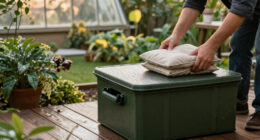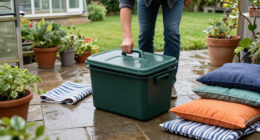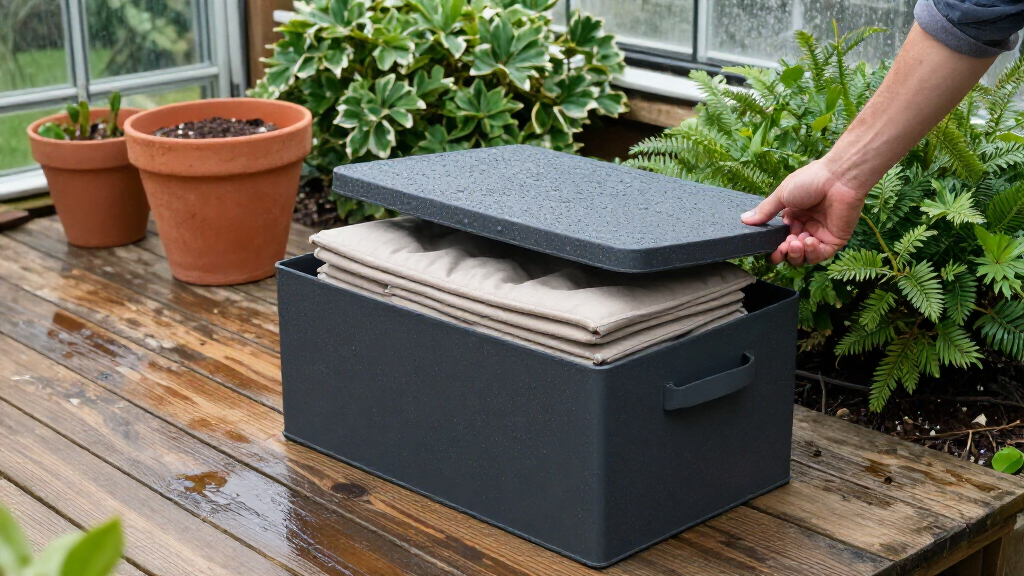
This guide helps homeowners and renters choose and set up an outdoor storage box for cushions, garden tools, or similar items. You will check the box’s capacity and weather protection, prepare a suitable location, assemble it safely, and confirm that the lid and drainage work as intended. The task is beginner-friendly and usually takes 1-2 hours, depending on assembly and the box size.

Get garden gear delivered free with Prime
- Fast, free delivery on millions of items
- Prime Video, Amazon Music and more included
- Member-only deals all year

Keter Westwood 150-Gallon Outdoor Storage Box and Bench
- ✔ Capacity: 150 gallons
- ✔ Exterior dimensions: 61 × 28.3 × 25.2 inches
- ✔ Interior dimensions: 56 × 24.6 × 22.8 inches

Devoko 100-Gallon Waterproof Resin Deck Box
- ✔ Capacity: 100 gallons
- ✔ Exterior dimensions: 48 × 22 × 24.5 inches
- ✔ Interior dimensions: 47.8 × 21.4 × 24.6 inches
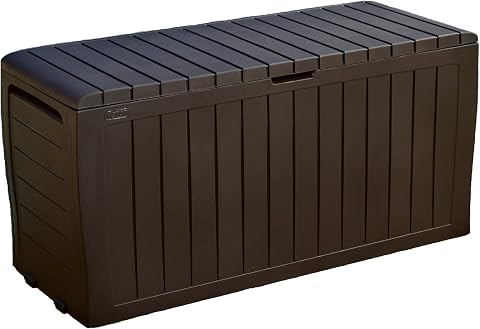
Keter Marvel 71-Gallon Outdoor Storage Box
- ✔ Capacity: 71 gallons
- ✔ Exterior dimensions: 45.9 × 17.4 × 22.2 inches
- ✔ Interior dimensions: 44.6 × 15.6 × 20 inches
Difficulty: Beginner | Time: 1-2 hours
What You’ll Need
Tools & Materials:
- Tape measure
- Level
- Screwdriver or drill with the correct bit, if assembly instructions call for one
- Work gloves
- Soft cloth
- Manufacturer’s assembly instructions
Knowledge:
- Basic measuring and household tool use
- Ability to follow the product’s assembly and care instructions
Check the product’s dimensions, capacity, weight limit, and care instructions before buying. “Weather-resistant” does not always mean fully waterproof. Keep electronics, paper, and other moisture-sensitive items in sealed inner containers unless the manufacturer confirms the box is suitable for them. Allow extra time if the box needs two people to lift or assemble.
Keter Westwood 150-Gallon Outdoor Storage Box and Bench
The Keter Westwood is our best overall choice because it combines the largest stated capacity here, 150 gallons, with a lid designed to seat two adults. That pairing makes it useful on a patio where cushions, pool supplies, and garden tools would otherwise need separate storage and seating. At 61 inches long, it has a substantial footprint, but it also offers more room than either the Devoko or the Marvel for bulky seasonal items.Its weather-resistant resin is described as resisting rusting, peeling, and denting, which makes it a practical alternative to a finish that needs more care. The lockable lid and easy-lift mechanism add convenience when accessing stored items. Compared with the Devoko, the Westwood is lighter at 39.1 pounds and has a higher stated seating limit of 660 pounds, but the Devoko is the one explicitly described as waterproof and includes gas rods. Compared with the Marvel, Westwood offers over twice the capacity, though it gives up the Marvel’s easy portability and tool-free assembly.We’d choose it when storage and bench use are both priorities and the deck has room to accommodate it. Assembly is required, and the single compartment won’t keep smaller items sorted. Buyers with a narrow balcony or only a few accessories should consider the Marvel instead; the Westwood’s capacity is wasted if its footprint crowds the space.
Pros:
- 150-gallon capacity for bulky outdoor belongings
- Lid doubles as seating for two adults, with a stated 660-pound limit
- Weather-resistant resin is described as resisting rust, peeling, and dents
- Lockable lid with an easy-lift opening mechanism
Cons:
- Large footprint needs ample outdoor space
- Assembly is required
- One compartment offers no built-in sorting
Best for: Patio owners who need high-capacity storage for cushions and pool supplies plus seating for two.
Not ideal for: People with limited deck space, small storage needs, or no interest in assembling a large box.
Bottom line: Choose the Westwood when we want the most storage and seating in one weather-resistant box and have room for its large footprint.
“Choose the Westwood when we want the most storage and seating in one weather-resistant box and have room for its large footprint.”
Devoko 100-Gallon Waterproof Resin Deck Box
The Devoko 100-Gallon is the middle ground for buyers who want more room than the Marvel offers without committing to the Westwood’s larger dimensions. Its 100-gallon capacity can handle outdoor cushions and tools, while the hinged lid with two gas rods is designed to open and close in a controlled way. A lockable lid adds a basic security option for stored belongings.Among these three, this is the only product explicitly described as waterproof; the others are described as weather-resistant. That wording may appeal to buyers who place water protection high on their list, though the supplied details do not define test conditions or promise protection under every exposure. It also doubles as a bench with a stated 500-pound limit, between the Westwood’s 660 pounds and Marvel’s 485. Its 48-inch exterior length is shorter than the Westwood’s 61 inches, but it weighs 55 pounds, making it heavier than both competitors despite its more moderate size.We’d favor Devoko when a controlled lid and stated waterproof construction are central to the decision. The tradeoff is mobility: once loaded, its weight can make relocation awkward, and the single compartment provides no separate place for small tools. Buyers who expect to move the box often may find the Marvel’s handles, rollers, and 15.6-pound weight more useful. Those seeking maximum volume should look to the Westwood.
Pros:
- 100-gallon capacity for cushions, tools, and accessories
- Product details describe the resin body as waterproof and UV-protected
- Two gas rods support controlled lid opening and closing
- Lockable bench lid has a stated 500-pound weight capacity
Cons:
- At 55 pounds, it is the heaviest of the three
- Single-compartment layout does not separate small items
- Waterproof performance conditions are not specified in the supplied details
Best for: Buyers seeking a 100-gallon box with a lockable, gas-rod lid and an explicitly stated waterproof design.
Not ideal for: Anyone who needs to move a loaded box frequently or wants separate compartments.
Bottom line: Pick the Devoko when its controlled, lockable lid and stated waterproof construction matter more than easy relocation.
“Pick the Devoko when its controlled, lockable lid and stated waterproof construction matter more than easy relocation.”
Keter Marvel 71-Gallon Outdoor Storage Box
The Keter Marvel trades capacity for convenience. At 15.6 pounds, with built-in handles and rollers, it is the easiest of these three to reposition, making it a sensible choice for patios where storage needs change or the box must be moved for cleaning. Its 71-gallon capacity suits smaller accessories, garden tools, or a modest cushion set, while the bench-style lid has a stated 485-pound weight capacity.Compared with the Westwood’s 150 gallons and two-person seating, the Marvel is clearly less suited to storing a full patio’s cushions. The Devoko holds more as well, at 100 gallons, and is the one explicitly described as waterproof. Marvel instead stands out for tool-free assembly in about five minutes and built-in mobility features. Its resin is described as weather-resistant and UV-resistant, which is useful for outdoor placement, though the information provided does not specify conditions or protection limits. The brown wood-look finish may suit buyers who want a plank-like appearance without choosing natural wood, but it remains plastic resin.We’d recommend it for balconies, smaller decks, and lighter storage loads where setup and moving the box matter more than maximum volume. Its dimensions are narrower and shorter than Westwood’s, but the interior still may not accommodate larger items. Skip it if you want to store bulky cushions or prefer a natural material; the Devoko or Westwood offers more capacity, while neither solves the natural-wood preference.
Pros:
- 71-gallon capacity in a relatively compact footprint
- Lightest option at 15.6 pounds, with handles and rollers
- Tool-free assembly takes about five minutes
- Bench-style lid has a stated 485-pound weight capacity
Cons:
- Less capacity than the 100-gallon Devoko and 150-gallon Westwood
- Compact interior may not fit larger items
- Plastic resin may not suit buyers seeking natural wood
Best for: People with limited patio space who want lightweight storage, straightforward assembly, and a movable bench-style lid.
Not ideal for: Buyers storing large cushions or seeking the highest capacity or a natural wood finish.
Bottom line: Choose the Marvel when easy setup and portability matter more than storing bulky patio items.
“Choose the Marvel when easy setup and portability matter more than storing bulky patio items.”
As an Amazon Associate we earn from qualifying purchases.
Before You Start
Inspect the intended location after rain if possible. Avoid low spots where water collects, areas beneath dripping gutters, and locations where snow or branches could block the lid. Check that the lid can open fully without hitting a wall, railing, or furniture. If wind is common where you live, check whether the manufacturer provides anchoring instructions and follow them; a large empty box can shift or tip.
Read the full assembly instructions before opening the package. Do not drill extra holes or seal factory drainage openings: either change can weaken the box or trap water.
Step-by-Step Instructions
Step 1: List what the box needs to hold
Write down the items you plan to store and measure the largest ones, including cushions when they are compressed only as much as you normally would store them. Group items by how often you use them and whether they can tolerate some humidity. Use these measurements to estimate the interior space you need; advertised exterior dimensions include the walls and lid.
Tip: Do not pack items tightly against the lid. Leave room for the lid to close without crushing fabric or catching straps.
Check: You have a list of the items, the largest item’s dimensions, and a rough capacity requirement.
Step 2: Choose a box suited to your climate and use
Compare the interior dimensions and usable capacity with your measurements. Check the product details for weather resistance, UV resistance, ventilation, drainage, lid support, weight limits, and any stated limits on exposure. Choose a material and finish that fit the location: resin is generally easy to clean, while wood may need periodic protective treatment. Pick a lid you can open safely when the box is loaded.
Tip: A box described as weather-resistant may not keep out wind-driven rain or standing water. Use sealed bags or containers inside for items that must stay dry.
Check: The box fits the planned items and its care and weather limits match the location.
Step 3: Measure and prepare the location
Measure the footprint and mark where the box will sit. Leave the clearance specified by the manufacturer and enough space to open the lid and remove stored items. Choose firm, level ground with water able to drain away. Clear stones, branches, and debris, then check the surface with a level.
Tip: If the ground is uneven or soft, use a stable, level base suited to the box and site. Do not place the box where its feet sink or where rainwater runs toward it.
Check: The marked area is level, clear, and large enough for the box and lid movement.
Step 4: Unpack and assemble the box
Open the package on a clean, flat surface and compare the parts with the instructions. Assemble the box in the listed order, using the specified fasteners and tools. Tighten connections as directed, but do not overtighten plastic parts. Ask another person to help lift large panels or position a heavy assembled box.
Tip: Keep small fasteners in a container while assembling. Stop if a panel does not align; forcing it can crack a part or make the lid fit poorly.
Check: All listed parts are installed, panels sit evenly, and no cracks or loose fittings are visible.
Step 5: Position and secure the box
Move the box onto the prepared spot and orient it so the lid opens toward the clear space. Check the level again, then follow the manufacturer’s anchoring method if one is provided. Keep any built-in drainage openings clear and confirm that water can flow away from the base.
Tip: Do not improvise anchors by drilling through the floor or walls unless the instructions allow it. Extra holes can admit water and affect the box’s strength.
Check: The box sits steadily, opens freely, and is anchored as specified for the site.
Step 6: Check the lid, drainage, and fit
Open and close the lid several times. Check that hinges, supports, and latches move smoothly and that the lid rests evenly on the rim. Look for the drainage or ventilation features described in the instructions and make sure they are not blocked. If the manufacturer recommends a water test, follow that procedure; do not use a pressure washer or force water into seams.
Tip: A lid that drops suddenly can injure fingers or damage contents. Keep hands clear of hinge points and replace or adjust a faulty support before loading the box.
Check: The lid closes without gaps caused by misalignment, stays supported as intended, and drainage paths remain open.
Step 7: Load items with moisture protection in mind
Make sure items are clean and dry before storing them. Put frequently used or heavier items where you can reach them without climbing into the box. Use sealed containers for small hardware and moisture-sensitive belongings. Keep items below the lid line and away from drainage openings, hinges, and the latch.
Tip: Let damp cushions or covers dry fully before storage. Trapped moisture can lead to mildew even inside a weather-resistant box.
Check: The lid closes easily, contents do not press against the hinges, and ventilation or drainage features are clear.
Common Mistakes to Avoid
- Buying based only on the advertised exterior dimensions. — Compare the usable interior dimensions with the items you measured, and leave space for easy loading and lid clearance.
- Placing the box on soft or sloped ground. — Use a firm, level surface so the box stays stable and the lid aligns correctly.
- Storing damp fabric or placing items over drainage openings. — Dry items before loading and keep drainage and ventilation paths unobstructed.
- Assuming weather-resistant means watertight in every condition. — Check the product’s stated limits and use sealed inner containers for items that cannot get damp.
Troubleshooting
Problem: The lid will not close evenly.
Solution: Remove the contents, check that panels and hinges are installed in the correct orientation, and confirm the box is level. Refit parts according to the instructions; do not force the lid shut.
Problem: Water collects beneath or around the box.
Solution: Move it to firmer, better-drained ground or prepare a suitable level base. Keep factory drainage openings clear and direct runoff away from the box.
Problem: The inside feels damp or stored items smell musty.
Solution: Remove and dry the contents, wipe the interior, and let it air out. Check for blocked vents, standing water, or rain exposure beyond the product’s rating; add sealed inner storage for sensitive items.
Problem: The box shifts or tips in wind.
Solution: Follow the manufacturer’s anchoring instructions and confirm the base is level and firm. Do not rely on stored contents alone to hold the box in place.
What Success Looks Like
The finished box stands level and stable in a drained location, with the lid opening and closing smoothly. Its drainage and ventilation features remain clear, planned items fit without obstructing the lid, and moisture-sensitive belongings have suitable inner protection. The product instructions confirm that the box is being used within its stated limits.
Next Steps
After the first heavy rain, inspect the area around the base and check stored items for dampness. Clean the box with the method recommended by its manufacturer, clear debris from vents and drainage paths, and dry stored fabrics before putting them away. Recheck the lid, fasteners, and anchors at the start of each outdoor season and after strong winds. Treat wood or other materials on the schedule specified for that product.
Frequently Asked Questions
Will an outdoor storage box keep everything completely dry?
Not necessarily. Weather resistance varies by product, and wind-driven rain, condensation, or standing water can still cause dampness. Check the stated rating and use sealed inner containers for items that must stay dry.
Can I put cushions away while they are slightly damp?
Let cushions and covers dry fully first. Storing damp fabric can cause mildew and odor, even when the box is designed for outdoor use.
Should I anchor the box?
Follow the manufacturer’s instructions and consider the exposure of the location. Anchoring can help in windy areas, but use only the approved method so you do not create holes that admit water or weaken the box.
How often should I clean and inspect the box?
Clear debris and inspect the lid, drainage, and anchors at least once each outdoor season. Check sooner after storms or if you notice water collecting, shifting, or a musty smell.