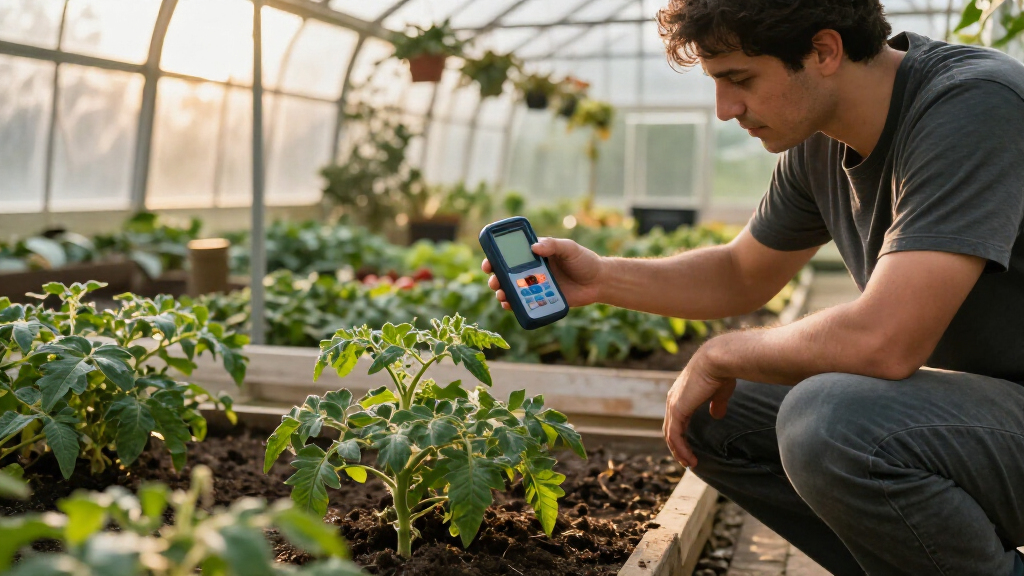
Choosing among the best grow light meters comes down to what you need to measure and how you plan to use the readings. My leading pick for expanded plant-light coverage is the Apogee Instruments MQ-610, which reads 400–750 nm and includes far-red light. For growers who want UVA readings and stored measurements for mapping, the AH-Quantuv offers a broader set of display modes. The PAR-355 is a more focused choice for scanning a canopy and comparing average, maximum, and minimum PPFD.

Get garden gear delivered free with Prime
- Fast, free delivery on millions of items
- Prime Video, Amazon Music and more included
- Member-only deals all year
Those strengths serve different jobs. Far-red coverage and rugged construction matter more to some growers than extra display modes; automated logging and environmental readings may matter more to greenhouse or research users than a straightforward PPFD check. I rank these five by how well their measurement range, data handling, and practical design fit distinct grow-light tasks. A meter with more features is not automatically the best choice if its extra functions go unused.
Complete the kit


Key Takeaways
- The Apogee MQ-610 is the only listed model with a stated 400–750 nm range, capturing far-red wavelengths beyond standard 400–700 nm PAR coverage.
- The AH-Quantuv combines PAR and UVA readings with blue, green, and red PAR breakdowns, while its 100-record memory stores PAR measurements only.
- The PAR-355 is the most scan-oriented option here: dynamic readings provide average, maximum, and minimum values, with space for up to 100 measurements.
- The DANOPLUS DP-355 adds a tripod socket and a display of the four most recent readings, but its stated wavelength tolerance is ±10 nm.
- The multi-function 400–700 nm meter adds environmental readings, spectral curves, DLI trends, and longer-term recording, at the cost of a shorter 0.8 m probe cable.
| Apogee Instruments MQ-610 ePAR Quantum Meter, 400–750 nm | 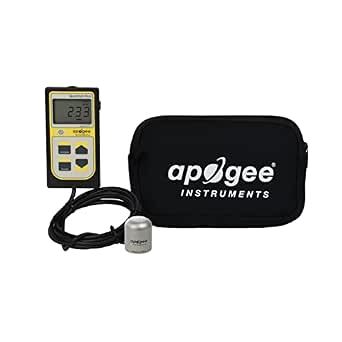 | Best Overall for Far-Red Coverage | Measurement range: 400–750 nm | Measurement accuracy: ±5% | Output type: Electrical signal | VIEW LATEST PRICE | See Our Full Breakdown |
| AH-Quantuv PAR and UVA Meter for Grow Lights |  | Best for UVA and Light Mapping | PAR measurement range: 400–750 nm | UVA measurement range: 320–400 nm | PAR breakdown: Blue, green, and red | VIEW LATEST PRICE | See Our Full Breakdown |
| Quantum PAR Meter for LED Grow Lights, 400–700 nm |  | Best for Scanning and Comparing Canopy Readings | PPFD measurement range: 0–5,000 μmol/m²/s | Wavelength range: 400–700 nm (±10 nm) | Data functions: Average, maximum, and minimum | VIEW LATEST PRICE | See Our Full Breakdown |
| Quantum PAR Meter for Plant Light Measurement, 400–700 nm | 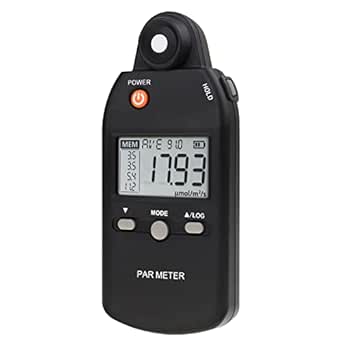 | Best for Stable, Straightforward Spot Checks | Measurement range: 0–5,000 μmol/m²/sec | Wavelength range: 400–700 nm | Wavelength tolerance: ±10 nm | VIEW LATEST PRICE | See Our Full Breakdown |
| Quantum PAR, PPFD, DLI, and Plant Light Meter, 400–700 nm |  | Best Premium-Style Choice for Ongoing Grow-Space Monitoring | Measurement range: 400–700 nm | Measurements: PAR/PPFD, temperature, humidity, color temperature, relative chlorophyll A/B | Display: 320 × 240 TFT color screen with real-time spectral curves | VIEW LATEST PRICE | See Our Full Breakdown |
| grow light meter | Item weight | Measurement range |
|---|---|---|
| Apogee Instruments MQ-610 ePAR | — | 400–750 nm |
| AH-Quantuv PAR and UVA Meter f | 6.7 ounces | — |
| Quantum PAR Meter for LED Grow | 8.8 ounces | — |
| Quantum PAR Meter for Plant Li | 8.8 ounces | 0–5,000 μmol/m²/sec |
| Quantum PAR | 11.3 ounces | 400–700 nm |
More Details on Our Top Picks
Apogee Instruments MQ-610 ePAR Quantum Meter, 400–750 nm
The MQ-610 earns my top spot because its 400–750 nm ePAR range captures far-red light from 700–750 nm, a band excluded from the 400–700 nm range used by the other PAR-focused meters here. That makes it the clearest match for growers who want their measurements to account for more of the light spectrum associated with plant growth, rather than relying on a conventional PAR window alone. Among these five options, it is the most specialized instrument for expanded spectral coverage.
Its physical design supports work around a canopy: the waterproof, potted machined-aluminum sensor is built for a more demanding grow space, and the tangle-free cable helps when checking readings across a wider area. A high-contrast display is a practical advantage when taking repeated measurements at different canopy points. The four-year warranty also separates it from models whose supplied details do not state a warranty period.
The tradeoff is focus. This meter is described for plant-light measurement, not general-purpose environmental monitoring, and its stated accuracy is ±5%. It does not offer the AH-Quantuv’s UVA channel and color-separated PAR display, nor the final meter’s temperature, humidity, and logging features. I would choose it for far-red-aware light assessment and a rugged sensor—not for buyers who primarily want extensive records or several types of environmental data.
Pros:- Measures 400–750 nm, including far-red light from 700–750 nm.
- Waterproof, potted machined-aluminum sensor suits grow-space use.
- Tangle-free cable helps with measurements across a larger canopy.
- Four-year warranty and high-contrast display.
Cons:- Specified measurement accuracy is ±5%.
- Designed for plant-light measurement rather than general-purpose monitoring.
- Does not list the UVA channel or environmental and time-series features found on other picks.
Best for: Growers who want ePAR readings through 750 nm, including far-red, and value a waterproof sensor for repeated measurements around a canopy.
Not ideal for: Buyers who need UVA measurements, environmental readings, automated logging, or a general-purpose meter rather than a dedicated plant-light instrument.
- Measurement range:400–750 nm
- Measurement accuracy:±5%
- Output type:Electrical signal
- Sensor material:Machined aluminum
- Waterproof:Yes
- Cable:Tangle-free
- Weight:6.4 ounces
- Warranty:Four years
- Country of manufacture:USA
Our verdict“I recommend the MQ-610 for growers who want the lineup’s clearest far-red coverage and a rugged sensor more than extra logging or environmental features.”
AH-Quantuv PAR and UVA Meter for Grow Lights
The AH-Quantuv is my pick for growers who want more than a single PAR figure. It measures PAR from 400–750 nm and UVA from 320–400 nm, then offers separate blue, green, and red PAR readings. That combination makes it more informative for comparing light sources or checking how different parts of the visible plant-light range vary across a growing area. Compared with the Apogee MQ-610, it adds a dedicated UVA mode; compared with the 400–700 nm meters, its stated PAR span extends farther into far-red.
Its strongest practical feature is measurement organization. The meter stores up to 100 PAR readings, has a hold function, and offers modes for PAR, UVA, RGB PAR breakdown, and historical records. That makes it a sensible mapping tool for someone who plans to take several readings across a canopy and review the results. The limitation is precise: the supplied information says the memory stores PAR measurements, not UVA measurements. Buyers should not assume its log contains a complete record of every mode.
It is also less ruggedly specified than the Apogee: the product details list CE certification and two included AAA batteries, but do not describe a waterproof sensor or a warranty. I would choose this over the DANOPLUS DP-355 when UVA and color-separated readings matter. If all you need is a familiar PPFD scan with average, maximum, and minimum values, the PAR-355 is more directly suited to that task.
Pros:- Measures PAR and UVA in separate wavelength ranges.
- Shows blue, green, and red PAR breakdowns.
- Stores up to 100 PAR readings for distribution mapping.
- Includes a hold function and multiple display modes.
Cons:- Recording function stores PAR measurements only.
- Requires two AAA batteries.
- Supplied details do not list waterproofing or a warranty.
Best for: Growers who want both UVA and PAR readings, separate blue/green/red PAR values, and stored PAR measurements for mapping a grow area.
Not ideal for: Buyers who need waterproof construction, want UVA readings stored alongside PAR, or only need straightforward PPFD readings and scan statistics.
- PAR measurement range:400–750 nm
- UVA measurement range:320–400 nm
- PAR breakdown:Blue, green, and red
- Recording capacity:Up to 100 PAR measurements
- Display modes:PAR, UVA, RGB PAR breakdown, and historical records
- Power:Two AAA batteries, included
- Item weight:6.7 ounces
- Manufacturer:De-Power
- Certification:CE
Our verdict“I favor the AH-Quantuv when UVA and color-separated PAR readings matter more than the Apogee’s rugged build or the PAR-355’s scan statistics.”
Quantum PAR Meter for LED Grow Lights, 400–700 nm
The PAR-355 is the most scan-oriented of the two conventional 400–700 nm meters in this lineup. Its dynamic mode records while scanning and calculates average, maximum, and minimum values. Those summaries can help a grower compare the brighter and dimmer parts of a canopy without relying on a single point reading. It also stores up to 100 measurements, giving it a more deliberate mapping workflow than a meter intended only for a quick spot check.
That makes it a stronger fit for growers adjusting light placement or looking for uneven coverage than the DANOPLUS DP-355, which emphasizes stored readings, recent-value display, and a tripod socket. The PAR-355 has a large display and the same stated 0–5,000 μmol/m²/s measurement range as the DANOPLUS model, but its supplied details do not list a tripod mount. Its wavelength range is 400–700 nm with ±10 nm noted, so it does not provide the far-red span of the Apogee or the AH-Quantuv.
The everyday tradeoff is a focused feature set. It needs two AAA batteries, and the product information does not specify a waterproof build, cable design, or warranty. I would put it ahead of the DP-355 for a buyer who wants scan-derived statistics, but choose the DANOPLUS if stable tripod positioning and quick access to the four latest readings are more useful than the average/minimum/maximum calculation.
Pros:- Measures PPFD from 0 to 5,000 μmol/m²/s across 400–700 nm.
- Dynamic mode calculates average, maximum, and minimum readings.
- Stores up to 100 measurements internally.
- Large display is intended to make readings easier to see.
Cons:- Requires two AAA batteries.
- Wavelength specification includes ±10 nm.
- Does not list a tripod socket or waterproof construction.
Best for: Growers who plan to scan multiple canopy points and want average, maximum, and minimum PPFD values plus internal storage.
Not ideal for: Buyers who need far-red or UVA coverage, a stated waterproof sensor, or a tripod socket included in the product specifications.
- PPFD measurement range:0–5,000 μmol/m²/s
- Wavelength range:400–700 nm (±10 nm)
- Data functions:Average, maximum, and minimum
- Measurement storage:Up to 100 values
- Display:Large display
- Model:PAR-355
- Power:Two AAA batteries
- Item weight:8.8 ounces
Our verdict“I recommend the PAR-355 over the simpler DANOPLUS when canopy scanning statistics matter more than tripod mounting and a recent-reading display.”
Quantum PAR Meter for Plant Light Measurement, 400–700 nm
The DANOPLUS DP-355 is a practical choice when the job is to take repeatable 400–700 nm PAR readings without moving into a more complex multi-mode instrument. It measures from 0 to 5,000 μmol/m²/sec, stores up to 100 values, and keeps the four most recent readings visible. The standout physical detail is its tripod socket: mounting the meter can help hold its position steady during measurements, which is useful when comparing readings from the same location over time.
Compared with the PAR-355, this model gives up the listed dynamic average, maximum, and minimum calculation in favor of a tripod socket and four-reading display. That is a real workflow distinction, not just a spec-sheet variation. If a grower wants to map a canopy by taking many manual readings, either model can store up to 100; if the goal is a stable fixed-position measurement, the DP-355’s socket is the clearer fit. The tripod itself is not included, so the mount only helps buyers who already have one or are willing to supply one.
The meter’s ±10 nm wavelength tolerance is another reason to treat it as a focused grow-light tool rather than a broad spectral analyzer. It does not extend into far-red like the Apogee and AH-Quantuv, and the supplied details do not list UVA, waterproofing, or environmental data. I would choose it for uncomplicated PPFD checks and tripod-supported positioning, not for users who want spectral breakdowns or scan summaries.
Pros:- Measures PAR from 0 to 5,000 μmol/m²/sec across 400–700 nm.
- Stores up to 100 readings and shows the last four.
- Tripod socket supports stable positioning.
- Portable design weighs 8.8 ounces.
Cons:- Tripod is not included.
- Wavelength tolerance is ±10 nm.
- Does not list scan statistics, UVA measurement, or far-red coverage.
Best for: Growers who want a portable PAR meter with saved readings, a display of recent values, and a tripod socket for stable positioning.
Not ideal for: Buyers who need far-red or UVA readings, automated scan statistics, or a tripod included with the meter.
- Measurement range:0–5,000 μmol/m²/sec
- Wavelength range:400–700 nm
- Wavelength tolerance:±10 nm
- Stored readings:Up to 100
- Recent readings display:Last four readings
- Tripod socket:Yes; tripod not included
- Item weight:8.8 ounces
- Manufacturer and model:DANOPLUS DP-355
Our verdict“I would pick the DP-355 for stable, repeatable spot checks, while choosing the PAR-355 if automatic scan statistics matter more than its tripod socket.”
Quantum PAR, PPFD, DLI, and Plant Light Meter, 400–700 nm
This is the broadest monitoring instrument in the group, combining PAR/PPFD with temperature, humidity, color temperature, and relative chlorophyll A/B measurements. Its 320 × 240 color display shows real-time spectral curves over 400–700 nm, while a built-in clock supports timestamps and a DLI trend curve. For a grower who wants to examine light alongside environmental conditions or review changes over time, that scope goes well beyond the simpler PAR meters.
The logging options are its main advantage over the rest of this list. It can store up to 200 manual data sets and record automatically for up to three days. A rechargeable battery avoids the AAA-battery requirement listed for the PAR-355 and AH-Quantuv, and the probe rotates 360 degrees for flexible positioning. Compared with the Apogee MQ-610, however, its stated wavelength range stops at 700 nm, so it is not the far-red pick. Its probe cable is only 0.8 m (2.6 ft), which may restrict placement in larger or awkward grow spaces.
This meter ranks fifth not because it lacks functions, but because its broad feature set is a different answer to the buying question. If a buyer mainly needs reliable canopy PPFD checks, the PAR-355 or DANOPLUS DP-355 offers a more focused approach; if UVA and spectral PAR bands are the priority, the AH-Quantuv is the closer match. I would select this model when environmental readings, visual spectral curves, and time-based DLI tracking justify the added complexity. The automatic recording period is limited to three days, so it is not a substitute for indefinite monitoring.
Pros:- Combines PAR/PPFD, temperature, humidity, color temperature, and relative chlorophyll A/B measurements.
- Displays real-time spectral curves and DLI trends.
- Stores up to 200 manual data sets and records automatically for up to three days.
- Rechargeable battery and 360-degree rotating probe support flexible use.
Cons:- Automatic recording is limited to up to three days.
- Probe cable is 0.8 m (2.6 ft) long.
- Its 400–700 nm range does not include the far-red extension measured by the Apogee MQ-610.
Best for: Greenhouse, grow-room, lab, or aquarium users who want light readings alongside environmental data, spectral curves, DLI trends, and timestamped records.
Not ideal for: Buyers seeking a simple PPFD meter, far-red coverage beyond 700 nm, a long probe cable, or automatic recording beyond three days.
- Measurement range:400–700 nm
- Measurements:PAR/PPFD, temperature, humidity, color temperature, relative chlorophyll A/B
- Display:320 × 240 TFT color screen with real-time spectral curves
- Manual data storage:Up to 200 data sets
- Automatic recording:Up to three days
- Clock:Built-in RTC
- Probe rotation and cable:360°; 0.8 m (2.6 ft)
- Battery:Rechargeable lithium polymer battery, included
- Item weight:11.3 ounces
Our verdict“I recommend this multi-function meter for growers who will use its environmental and time-series tools, but not for buyers who only need basic canopy PPFD readings.”
How We Picked
I compared these meters by the decisions a grower needs to make: whether a light is strong enough at canopy level, whether coverage is even, whether a particular wavelength band matters, and whether the reading should be recorded over time. I gave priority to measurement scope and useful data handling, then weighed portability and practical features such as a waterproof sensor, cable length, display, or tripod mounting.
The list includes meters with different jobs rather than treating every display as interchangeable. The Apogee ranks first for its explicit far-red range and rugged, waterproof sensor. The AH-Quantuv follows for growers who need UVA as well as PAR and want stored readings for mapping. The PAR-355 earns a place for its live scan statistics, while the DANOPLUS DP-355 offers a simpler reading-and-positioning approach with memory and a tripod socket. The final meter sits in a separate category: it is the most feature-rich for environmental and time-based monitoring, but its broad feature set and short probe cable make it less straightforward for basic spot checks.
I used the supplied specifications and product details, not assumptions about performance beyond them. Where accuracy or tolerance is stated, I include it as a buying factor rather than implying that a listed wavelength range alone guarantees a particular measurement result. I also distinguish storage types: the AH-Quantuv records PAR measurements, while the final meter supports manual data sets and automatic recording. These differences affect how useful a meter is for a canopy map, a quick check, or a time series.
Factors to Consider When Choosing Best Grow Light Meters
I would start by deciding what question the meter needs to answer. A canopy check, a spectrum comparison, and a multi-day environmental record are different tasks. The most useful grow light meter is the one whose wavelength coverage and data functions match that task, not necessarily the one with the longest feature list.
Choose the wavelength range for the light you care about
Most options here focus on 400–700 nm, the range used by standard PAR meters. That suits many growers who need PPFD readings from a grow light and want to compare light levels at plant height. The Apogee MQ-610 and AH-Quantuv both list a wider 400–750 nm range; the Apogee is especially distinct because its ePAR description explicitly calls out far-red from 700–750 nm. The AH-Quantuv adds a separate UVA range of 320–400 nm.
Those extra bands are useful only if they answer a question you have. If your goal is basic PPFD mapping under a conventional grow light, a 400–700 nm meter may be enough. If you are deliberately evaluating far-red or UVA, choose a meter that measures the relevant band rather than assuming a standard PAR reading covers it. Also distinguish wavelength coverage from measurement accuracy: the listed range tells you which wavelengths are included, not how exact every reading will be.
Match data features to your measurement routine
For a quick check, a direct reading may be all you need. If you plan to measure several points around a canopy, stored readings can help keep the comparison organized. The AH-Quantuv and both 355 models list capacity for up to 100 readings, though their workflows differ. The AH-Quantuv can show historical records and stores PAR measurements; the DANOPLUS displays the last four readings; the PAR-355 adds average, maximum, and minimum calculations during a scan.
For a longer time series, the multi-function meter stores up to 200 manual data sets and supports automatic recording for up to three days, with timestamps and a DLI trend curve. That can serve users who want to examine changes over time, but it is more capability than a simple spot-check routine needs. I would pick scan statistics for canopy uniformity, a fixed-position mount for repeatable point checks, and automatic logging when changes over hours or days are part of the question.
Think about measurement position and physical setup
A useful reading depends on placing the sensor where the plant receives light. Consider whether you will move across a wide canopy, take readings in a damp environment, or hold the sensor at one fixed point. The Apogee’s waterproof sensor and tangle-free cable suit more demanding handling and broad movement. The DANOPLUS DP-355 includes a tripod socket for stable positioning, but not the tripod itself. The final meter’s rotating probe offers positioning flexibility, although its 0.8 m cable may limit reach compared with what some setups require.
Weight and display also affect repeated work. The Apogee and AH-Quantuv weigh 6.4 and 6.7 ounces, while both 355 models are listed at 8.8 ounces; the multi-function unit weighs 11.3 ounces. These figures do not decide measurement quality, but a lighter meter can be easier to carry between plants. A high-contrast or large display can also make repeated readings easier to check at a glance.
Check the stated accuracy and limits
Do not treat all specifications as equivalent. The MQ-610 lists measurement accuracy of ±5%; the DANOPLUS DP-355 lists a wavelength tolerance of ±10 nm, and the PAR-355 gives a 400–700 nm range with ±10 nm in its wavelength specification. Wavelength tolerance and measurement accuracy describe different aspects of a meter, so I would not compare them as if they were the same figure. The supplied details do not provide a matching accuracy figure for every model.
If precision requirements are central to your work, review the manufacturer documentation for calibration, measurement conditions, and any application-specific guidance before buying. The product details in this comparison are enough to distinguish broad capabilities and workflows, but they do not establish that every meter is interchangeable for controlled research or other demanding use.
Avoid paying attention to features you will not use
Extra modes can be helpful, but they add little if you only need a single PPFD check. The AH-Quantuv’s UVA and RGB PAR modes are useful for spectrum-focused comparisons; the multi-function meter’s humidity, temperature, chlorophyll, spectral curves, and DLI trend support a broader monitoring routine. By contrast, a grower who only wants to adjust fixture height may find the PAR-355’s scan statistics or the DANOPLUS tripod socket more relevant.
I would shortlist by the one feature that changes your decision: far-red coverage, UVA readings, mapping, stable positioning, or time-based monitoring. Then check its drawbacks, including the AH-Quantuv’s PAR-only stored readings, the 355 models’ narrower wavelength range, and the final meter’s short probe cable and three-day automatic recording limit. This keeps the choice tied to the work rather than to feature count.
Frequently Asked Questions
What does a grow light meter measure?
A grow light meter measures light reaching a sensor, with plant-focused models commonly reporting PAR or PPFD. The wavelength range depends on the model: the three 400–700 nm options cover a standard PAR range, while the Apogee MQ-610 and AH-Quantuv list 400–750 nm, and the AH-Quantuv also measures UVA from 320–400 nm. Some meters add stored readings, scan calculations, environmental measurements, or DLI trends, so it is worth checking which output fits your purpose.
Do I need a meter that measures far-red light?
You need far-red coverage if you specifically want readings that include wavelengths from 700–750 nm. The Apogee MQ-610 explicitly measures that band, and the AH-Quantuv lists a 400–750 nm PAR range. The other three models in this roundup are specified for 400–700 nm. If you only need conventional PPFD checks within that range, the added coverage may not change your choice; if far-red is part of your lighting assessment, the meter must include it.
Which meter is best for mapping light across a canopy?
For a scan that summarizes uneven coverage, I would look first at the PAR-355 because its dynamic mode calculates average, maximum, and minimum readings and it stores up to 100 values. The AH-Quantuv is another strong mapping candidate when UVA and blue/green/red PAR readings matter, although its memory stores PAR measurements only. The DANOPLUS DP-355 also stores up to 100 readings and shows the latest four, but it does not list the same scan statistics.
Can a grow light meter track DLI over time?
The multi-function meter in this roundup lists a DLI trend curve, a built-in clock, timestamped data, and automatic recording for up to three days. That makes it the clearest choice here for reviewing light patterns over time. The other models list readings or measurement storage, but their supplied details do not describe the same DLI trend and automatic-recording combination. Check the product documentation for how the meter calculates and presents DLI.
Should I choose a multi-function meter or a simple PAR meter?
I would choose a simple PAR meter if the main job is checking or mapping PPFD at plant level; the PAR-355 and DANOPLUS DP-355 are focused options with different handling features. Choose the multi-function meter if you will use its temperature, humidity, color temperature, chlorophyll, spectral-curve, and DLI tools. Its broader scope comes with a shorter 0.8 m probe cable and automatic recording limited to three days, so those extras make sense only if they fit your routine.
Conclusion
For growers who want far-red-aware ePAR readings and a waterproof sensor, I would choose the Apogee Instruments MQ-610. If UVA measurement and color-separated PAR readings are the priority, the AH-Quantuv is the better fit. For canopy scans with average, maximum, and minimum values, the PAR-355 offers the most directly relevant workflow; choose the DANOPLUS DP-355 instead when a tripod socket and four recent readings suit your measurement routine better.
For greenhouse or grow-space users who want light data alongside environmental readings and time-based trends, the multi-function meter is the most capable choice, provided its 0.8 m cable and three-day automatic log window fit the setup. My final rule is simple: buy for the measurement you will actually make. A narrow, clear task favors one of the focused PAR meters; a spectrum or monitoring question calls for the broader instrument built to answer it.
Black Friday Picks

Vitamix Propel Series 510 Professional-Grade Blender, Black
As an affiliate, we earn on qualifying purchases.