Harnessing IoT sensors allows you to monitor your greenhouse in real time by providing accurate data on temperature, humidity, soil moisture, and light levels. This technology enables you to make quick, informed decisions about climate control, irrigation, and lighting, improving plant health and yields. Proper calibration and security keep your system reliable, while centralized data helps automate adjustments. Keep exploring further insights to fully optimize your greenhouse using these powerful tools.
Key Takeaways
- IoT sensors provide real-time data on environmental factors, enabling prompt adjustments for optimal greenhouse conditions.
- Proper sensor calibration ensures accurate measurements, preventing data drift and enhancing decision-making reliability.
- Implementing robust security measures protects sensitive data and maintains system integrity during wireless transmission.
- Regular sensor maintenance and selection of high-quality devices improve accuracy, durability, and system longevity.
- Centralized data integration facilitates trend analysis, automation, and proactive management for increased greenhouse productivity.
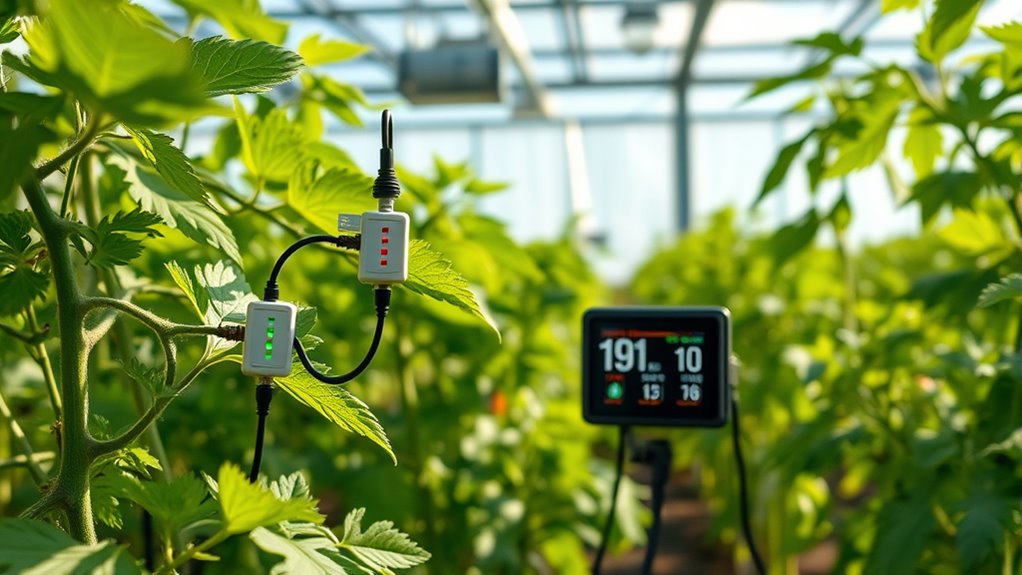
Greenhouse monitoring has become more efficient and accurate thanks to the advent of IoT sensors. These devices provide real-time data on temperature, humidity, soil moisture, and light levels, allowing you to make informed decisions quickly. To guarantee your sensors deliver reliable readings, proper sensor calibration is essential. Regular calibration adjusts the sensors to match standard measurements, preventing drift over time that could lead to inaccurate data. When you calibrate your sensors correctly, you gain confidence that the data you’re relying on reflects the true conditions inside your greenhouse. This accuracy helps you optimize climate controls, irrigation schedules, and lighting, ultimately improving plant growth and yield. Additionally, understanding angel numbers can inspire a mindful approach to managing your greenhouse environment, fostering patience and positive energy in your work.
However, as you incorporate IoT sensors into your greenhouse, you must also prioritize data security. With sensitive environmental data being transmitted wirelessly, there’s a risk of unauthorized access or cyber threats. Implementing robust security measures — such as encrypted data transmission, secure Wi-Fi networks, and strong authentication protocols — safeguards your information from theft or tampering. Protecting your data ensures that your decision-making remains based on trustworthy information, and it prevents potential disruptions caused by malicious attacks. Securing your IoT infrastructure isn’t just about avoiding breaches; it’s about maintaining the integrity and reliability of your entire monitoring system.
Beyond calibration and security, you should also consider the importance of consistent sensor maintenance. Sensors can degrade over time due to environmental factors, dust, or wear and tear. Regular checks and maintenance help maintain their accuracy and prolong their lifespan. Additionally, selecting high-quality sensors designed for greenhouse conditions minimizes calibration issues and enhances durability. When you invest in reliable sensors and keep them properly maintained, you create a stable foundation for your monitoring system that can adapt to changing conditions and grow with your needs.
Furthermore, integrating your sensors with a centralized data platform enables seamless analysis and visualization. When your data is securely stored and accurately calibrated, the insights you gain become more meaningful. You can spot trends, identify potential problems early, and automate responses based on real-time information. This proactive approach reduces manual labor and helps you maintain optimal growing conditions at all times. Ultimately, leveraging IoT sensors with proper calibration and data security practices empowers you to manage your greenhouse more efficiently, ensuring healthier plants and increased productivity.
Frequently Asked Questions
How Do Iot Sensors Improve Crop Yield Consistency?
IoT sensors improve crop yield consistency by providing real-time data on environmental conditions, allowing you to make precise adjustments. Regular sensor calibration guarantees accurate readings, while data analytics help identify patterns and optimize watering, temperature, and humidity. With this approach, you can prevent stress on plants, reduce waste, and achieve more uniform growth, ultimately boosting your crop yields and maintaining quality across harvests.
What Are the Cybersecurity Risks of Iot Greenhouse Systems?
Ironically, your high-tech greenhouse faces cybersecurity vulnerabilities just like any digital system. Hackers could exploit weak spots, risking data privacy breaches or disrupting your sensor data flow. These vulnerabilities might lead to unauthorized access, manipulation of environmental controls, or theft of sensitive data. So, while IoT systems boost efficiency, you must stay vigilant against cyber threats, ensuring your greenhouse stays secure and your data stays private.
How Cost-Effective Is Implementing Iot Sensors at Scale?
Implementing IoT sensors at scale can be cost-effective if you carefully plan your sensor deployment and conduct a thorough cost analysis. While initial investments might seem high, the long-term savings from optimized resource use and improved crop yields often outweigh these costs. By strategically choosing sensor types and monitoring needs, you can maximize benefits and guarantee a more efficient greenhouse operation, making it a worthwhile investment.
Can Iot Sensors Operate in Extreme Environmental Conditions?
You’ll be glad to know that many IoT sensors are designed for extreme environments, with some boasting up to 10 years of durability. Their sensor durability and environmental resilience allow them to operate in harsh conditions like high humidity, extreme temperatures, and dust. Manufacturers often build these sensors with rugged materials, ensuring consistent performance. So, yes, many IoT sensors can handle extreme environmental conditions effectively, providing reliable data in challenging settings.
What Maintenance Is Required for Long-Term Sensor Accuracy?
To keep your IoT sensors accurate long-term, you need to regularly perform sensor calibration to ensure data remains precise. Also, check and replace batteries as needed to prevent power failures that could disrupt monitoring. Keep an eye on sensor performance and clean them periodically to remove dust or debris. These steps help maintain reliable readings, guaranteeing your greenhouse stays effectively monitored and managed over time.
Conclusion
By now, you see how IoT sensors make greenhouse monitoring more efficient and responsive. They allow you to catch issues early and optimize plant growth effortlessly. Imagine the difference it could make in your crop yield and sustainability efforts. Isn’t it time you embraced this technology to give your greenhouse the advantage it deserves? With IoT sensors, you’re not just monitoring — you’re transforming your farming future. Are you ready to take that step?