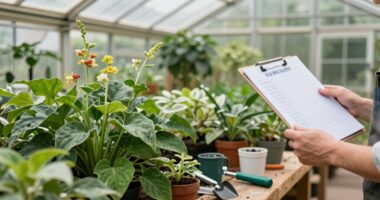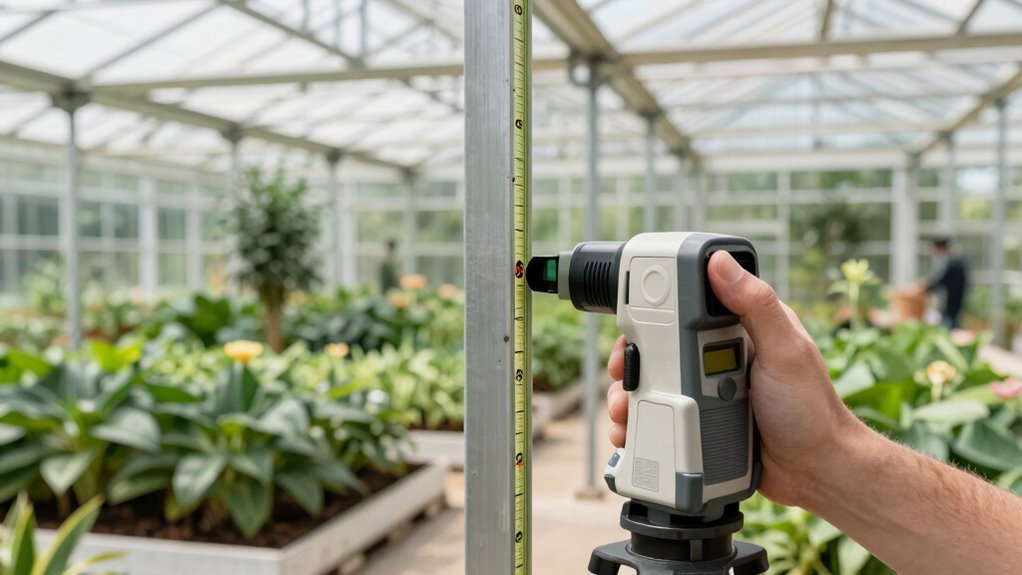

To accurately gauge greenhouse dimensions, measure the length, width, and height precisely with a tape measure or laser tool. Convert these measurements into a detailed layout plan, considering plant spacing, airflow, and accessibility. This helps prevent overcrowding and guarantees proper light and ventilation. By understanding these measurements, you can better visualize your space and plan for growth. Keep exploring to discover more tips for optimizing your greenhouse setup.

Get garden gear delivered free with Prime
- Fast, free delivery on millions of items
- Prime Video, Amazon Music and more included
- Member-only deals all year
Key Takeaways
- Use a reliable measuring tape or laser distance meter for accurate length, width, and height readings.
- Measure multiple points along each dimension to account for any irregularities or uneven surfaces.
- Record measurements carefully and double-check for consistency before planning layout.
- Convert all measurements to a common unit (e.g., feet or meters) for easier comparison and planning.
- Visualize the space by sketching a scaled floor plan to prevent misjudging available room.
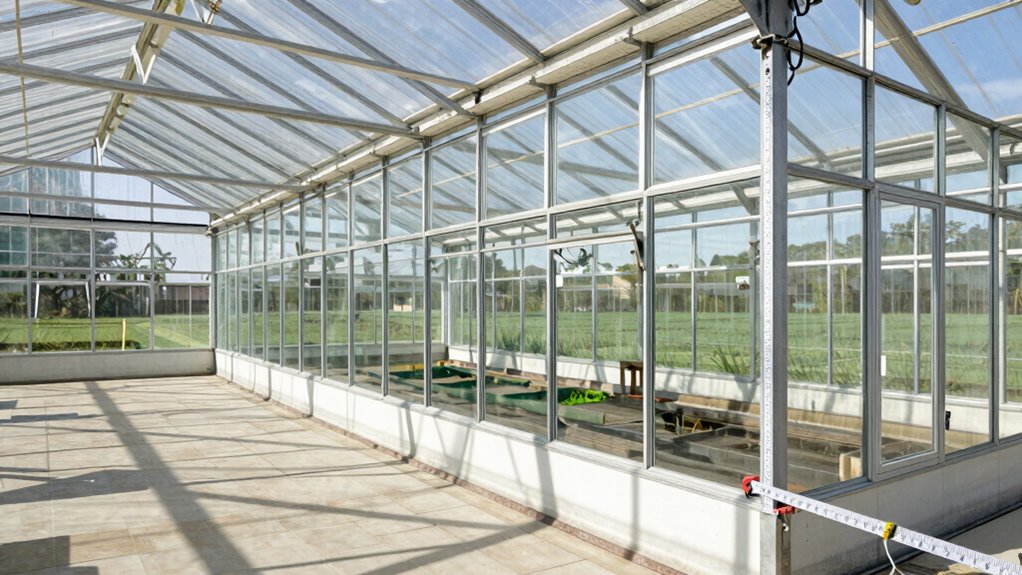
Understanding greenhouse dimensions is essential for optimizing your space and ensuring your plants thrive. When you grasp the measurements correctly, you can design a layout that maximizes growth potential and minimizes waste. One of the first things you should focus on is your plant layout. Knowing the exact dimensions allows you to arrange your plants efficiently, providing enough space for each to grow without overcrowding. Proper spacing improves airflow, light exposure, and accessibility, all of which are *crucial* for healthy development. To achieve this, you need to measure your greenhouse’s length, width, and height carefully, then translate those numbers into a practical layout plan. Visualize where each bed, pot, or shelf will go, ensuring there’s enough room for movement and maintenance. This planning process can be simplified by creating a detailed layout plan, which helps you visualize the space more effectively. This way, your plants get the room they need to flourish, and you maintain an organized, functional space. Accurately understanding your greenhouse’s spatial measurements is also key to effective ventilation planning**, ensuring your plants stay healthy and well-ventilated. Additionally, understanding the space requirements for different plant types can help you make better decisions when designing your layout. Recognizing the importance of precise measurements can also prevent costly mistakes and help you make informed decisions about greenhouse design. Developing a good understanding of these measurements can also aid in future expansion** planning, should you wish to grow more plants later on.
laser distance meter for greenhouse measurement
As an affiliate, we earn on qualifying purchases.
As an affiliate, we earn on qualifying purchases.
Frequently Asked Questions
What Tools Are Best for Measuring Greenhouse Dimensions Accurately?
You should use a measuring tape or a laser measure for accurate greenhouse dimensions. Measuring tapes are versatile for short distances and tight spots, while laser measures excel at longer, open areas, providing quick and precise readings. Both tools help you avoid misjudging space, ensuring your greenhouse fits perfectly. For best results, combine the two, especially when measuring complex or irregular shapes, to get thorough, reliable measurements.
How Do Seasonal Changes Affect Greenhouse Size Measurements?
Seasonal fluctuations can affect greenhouse size measurements by causing expansion or contraction of materials like metal or plastic, which impacts measurement accuracy. In colder months, materials may contract, making the greenhouse appear slightly smaller, while in warmer months, they expand, making it seem larger. To guarantee precise measurements year-round, account for these seasonal changes, and consider measuring during stable weather conditions to maintain measurement accuracy.
Can Irregularly Shaped Greenhouses Be Measured Effectively?
Ever wondered if you can accurately measure an irregularly shaped greenhouse? Absolutely. Greenhouse geometry plays a key role here, and shape measurement requires breaking down complex forms into manageable sections. Using tools like a flexible tape measure or digital plan, you can trace the outline and calculate areas precisely. Don’t forget to account for all angles and curves—this guarantees your measurements reflect the true size, no matter the shape.
What Are Common Mistakes When Estimating Greenhouse Space?
When estimating greenhouse space, you tend to make measurement errors by relying solely on visual guesses or skipping precise tools. Common mistakes include ignoring irregular shapes and not using proper estimation techniques like measuring multiple sections and averaging results. You should double-check dimensions, use a tape measure for accuracy, and consider the shape’s complexity. These habits help prevent misjudging the actual space, ensuring better planning and resource allocation.
How Do I Compare Greenhouse Sizes for Different Types of Plants?
To compare greenhouse sizes for different plants, consider plant density and space optimization. You want to match the greenhouse’s dimensions to each plant’s growth habits, ensuring enough room for healthy development. Larger plants need more space, while compact ones require less. By analyzing how efficiently you can utilize space and maintain proper plant density, you’ll determine which greenhouse size best suits each plant type, avoiding overcrowding or wasted space.
Conclusion
Just like fitting a puzzle piece perfectly into its spot, reading greenhouse dimensions accurately guarantees you make the most of your space. I once underestimated my greenhouse’s height and had to rethink my shelving plans—turns out, a quick double-check saved me from costly mistakes. Remember, precise measurements are your best tool to avoid surprises. When you understand your space, you’ll build a thriving garden that feels just right—no misjudging needed.
Halloween Picks
halloween
As an affiliate, we earn on qualifying purchases.