
Finding the best dual outlet thermostats for greenhouse heat and fans means balancing reliable temperature control with ease of use and durability. The AC Infinity Outlet AI stands out for its smart WiFi features and precise control, making it ideal for tech-savvy growers. The Temperature Controlled Outlet offers heavy-duty performance for larger setups, while the DEWENWILS Digital Temperature Controller provides excellent value with versatile features. Each option presents tradeoffs in price, complexity, and feature set, so understanding your specific needs is key. Continue reading to see how these choices compare and which model suits your greenhouse best.
Key Takeaways
- Top models balance ease of installation with precise temperature regulation for greenhouse environments.
- Smart WiFi controllers offer remote management but tend to be more expensive and complex.
- Heavy-duty thermostats excel for larger, high-demand setups but may have steeper learning curves.
- Pricing varies widely, with budget options suitable for small setups and premium models for advanced control.
- Most models include dual outlets, but features like humidity control and app integration differentiate top picks.




More Details on Our Top Picks
Attic Fan Thermostat Controller Temperature Switch Plug Outlet for Seedlings, Germination, Rooting, Greenhouse, Fermentation, Reptile, Terrarium Heating Mats
This thermostat stands out for its ability to handle both heating and cooling devices simultaneously, thanks to its dual relay system, making it ideal for complex greenhouse setups or fermentation chambers. Unlike simpler models, it offers a wide power load capacity of 1200W and a dual display of measured and set temperatures, providing clear feedback during operation. The beeping alarm ensures safety against sensor failures or high temperatures, a feature missing in many basic controllers. Setup is straightforward with its plug-and-play design, but its relatively higher power capacity and dual relay mean it’s bulkier and slightly more expensive than single-output options like the BN-LINK. It’s perfect for growers or hobbyists managing multiple heating and cooling elements where reliability and flexibility matter most. However, it may be overkill for small seedling trays or simple heat mats. Overall, this model best suits those needing a robust, all-in-one solution with precise temperature control and safety features.
Pros:- Supports both heating and cooling devices simultaneously
- Maximum output load of 1200W for heavy-duty applications
- Dual display showing current and target temperatures
- Beeping alarm for high temperature or sensor failure
Cons:- Higher price point compared to single-outlet thermostats
- Bulkier size may be less suitable for compact setups
- Requires some understanding of temperature calibration for optimal use
Best for: Greenhouse operators or fermentation enthusiasts who require simultaneous heating and cooling control with safety alarms.
Not ideal for: Small-scale hobbyists using only a single heat mat or basic terrarium setups, due to its larger size and complexity.
- Voltage:120 Volts
- Display Type:LCD
- Operating Temperature:210 Degrees Fahrenheit
- Max Load:1200W (10A)
- Size:8.26″L x 2.16″W x 1.57″H
- Weight:16 ounces
Bottom line: This thermostat is best for users needing a flexible, dual-relay system with safety features for larger or more complex greenhouse environments.
WH2408 Temperature Controller 10A 1200W, Digital Thermostat Controlled Outlet Plug Switch for Reptile Terrarium Greenhouse Homebrew Aquarium Seedling Mat, Heating or Cooling Mode
Compared with the AC Infinity Outlet AI, which offers smart WiFi connectivity, the WH2408 provides straightforward, manual adjustment via two knobs, making it ideal for those who prefer simple, reliable operation without app dependencies. Its temperature range from -58°F to 230°F and 0.1°F control resolution ensure precise regulation for a variety of applications, from reptile tanks to greenhouses. The built-in food-grade probe adds versatility, and the device’s robust ABS shell guarantees safety and durability. While lacking WiFi control, it compensates with ease of use and consistent performance, but it’s less suited for users seeking remote monitoring or integration with smart home systems. This makes it a fitting choice for hobbyists or small-scale growers who want dependable temperature regulation without extra complexity. Nonetheless, anyone requiring remote control or advanced scheduling might find the AC Infinity Outlet AI more fitting. This model is ideal for those prioritizing straightforward, accurate temperature control at a reasonable price.
Pros:- Simple two-knob adjustment for temperature control
- Wide temperature range from -58°F to 230°F
- High control resolution of 0.1°F
- Includes food-grade probe for versatile applications
Cons:- No WiFi or app control for remote monitoring
- Limited scheduling features compared to smart models
- Less suited for complex multi-zone environments
Best for: Hobbyists or small-scale growers needing a reliable, easy-to-use thermostat without smart features.
Not ideal for: Growers who want remote monitoring or integration into a smart home ecosystem, as it lacks WiFi connectivity.
- Voltage:120 Volts
- Max Load:1200W (10A)
- Temperature Range:-58°F to 230°F
- Control Resolution:0.1°F
- Probe Type:Food-grade
- Size:6.6 x 3.6 x 3.6 inch
Bottom line: This thermostat offers a dependable, straightforward solution for users who prioritize accuracy and simplicity over smart features.
AC Infinity Outlet AI, Environment Controller, Smart WiFi Power Strip, Dual-Zone Temperature Humidity, Individual Control 4 Plugs, AI Targeting, Thermostat Greenhouse Aquarium Terrarium Home, 1800W
This smart WiFi-enabled power strip excels in environments where multiple zones need regulation, offering independent control over four outlets, including dual-zone temperature and humidity tracking. Unlike the WH2408, which is manual, the AC Infinity Outlet AI allows remote operation via an app, with real-time alerts and AI-powered insights, making it perfect for high-tech greenhouse setups or professional grow rooms. Its capacity of 1800W and individual outlet control provide unmatched flexibility, but it comes with a higher price tag and some complexity in setup. It’s less suitable for users who prefer simple plug-and-play devices or don’t need remote access. The AC Infinity is ideal for growers managing multiple parameters and seeking integration with their smart home systems, though overkill for basic heat mats or single-zone applications. If remote control and comprehensive data monitoring are priorities, this model is the clear choice.
Pros:- Independent control over four outlets
- WiFi connectivity for remote monitoring and adjustment
- Dual-zone temperature and humidity tracking
- AI insights and real-time alerts
Cons:- Higher cost compared to basic thermostats
- Setup and configuration are more complex
- Overkill for single-zone, simple applications
Best for: Professional growers or tech-savvy hobbyists managing multiple environmental parameters in grow spaces.
Not ideal for: Small-scale or budget-conscious users who only need basic temperature control without smart features.
- Max Power:1800W
- Zones:Dual-zone temperature and humidity
- Connectivity:WiFi
- Number of Outlets:4
- Control Type:Smart app-based
- Size:Approx. standard power strip dimensions
Bottom line: This smart controller is best for users needing multi-zone, remote environmental management with AI insights for professional setups.
Temperature Controlled Outlet, Heavy Duty 15A 1800W Heating Cooling Thermostat Plug Outlet, -40℉~210℉ LCD Display Plug in Thermostat for Heater Greenhouse Incubator Homebrew Heat Lamp
Compared to the DEWENWILS model, which offers cyclic timing and countdown functions, this ZILLSEA controller provides a very straightforward, heavy-duty solution for controlling high-power heaters or coolers. Its 15A capacity of 1800W makes it suitable for large incubators or greenhouses that demand reliable, continuous operation. The LCD display with backlight enhances visibility in darker environments, and its broad temperature range from -40°F to 210°F covers most needs, from freezing to high heat. However, it lacks the advanced scheduling or WiFi features of the AC Infinity AI or DEWENWILS models, which can limit automation possibilities. It’s ideal for users who need durable, high-capacity control without the fuss of smart tech, but it’s less suited for those seeking remote or programmable features. This makes it ideal for straightforward, heavy-duty applications where simplicity and power handling are priorities.
Pros:- Heavy-duty 15A, 1800W capacity for large heaters
- Wide temperature range from -40°F to 210°F
- Backlit LCD display for visibility in dark settings
- Simple plug-in operation
Cons:- No WiFi or app control
- Limited automation features
- No built-in safety alarms or advanced scheduling
Best for: Growers or hobbyists who want a rugged, reliable thermostat for high-power heating or cooling without smart features.
Not ideal for: Users needing remote control, scheduling, or integration with smart home systems, as this model is purely manual.
- Voltage:120V
- Max Load:1800W (15A)
- Temperature Range:-40°F to 210°F
- Display Type:LCD with backlight
- Size:Approx. standard size
- Warranty:1 year
Bottom line: This thermostat is best for users requiring a durable, high-capacity control solution without smart features for large-scale or high-power applications.
DEWENWILS Digital Temperature Controller, Heavy Duty 15A/1800W Thermostat Outlet Plug, VA Display Heating Cooling Control Timer, -40℉~210℉, Cyclic Timing/Countdown, for Greenhouse Incubator Homebrew
In a similar category, the DEWENWILS controller distinguishes itself with its cyclic timing and countdown functions, perfect for automating complex heating or cooling schedules in greenhouses or incubators. Its VA display ensures clear readings in dim environments, and the device’s 15A/1800W capacity makes it suitable for high-power applications. The inclusion of timing modes allows for precise automation, reducing manual intervention, unlike simpler models like the ZILLSEA. However, its increased feature set adds some complexity to setup and operation, which may be daunting for beginners. It’s best suited for experienced growers who need programmable, heavy-duty control, but not ideal for those who prefer simple, manual operation. Overall, this unit provides a reliable, feature-rich solution for demanding environments needing scheduled temperature control.
Pros:- Supports cyclic timing and countdown modes
- High power capacity of 1800W / 15A
- VA display for clear, easy reading
- Suitable for both heating and cooling applications
Cons:- More complex setup process
- Overkill for simple, manual control needs
- No WiFi or remote access
Best for: Experienced growers or hobbyists seeking programmable, automated control for high-capacity heating or cooling devices.
Not ideal for: Beginners or users needing only basic on/off functionality, due to its complex setup and programming features.
- Voltage:120V
- Max Load:1800W (15A)
- Temperature Range:-40°F to 210°F
- Display Type:VA
- Features:Cyclic timing, countdown, heating/cooling modes
- Warranty:1 year
Bottom line: This controller is ideal for users who want precise, programmable automation with high power capacity in demanding environments.
Digital Temperature Controller, Heating & Cooling Thermostat Plug Outlet, –40°F~210°F, 15A 1800W, LCD Display, Temperature Controlled Outlet for Home, Greenhouse, Chicken Coop, Reptile
This digital controller stands out for its impressive versatility and high power capacity, supporting up to 15A / 1800W, making it suitable for a wide range of applications like greenhouse heating, fan control, or incubators. Its precise temperature measurement from –40°F to 210°F with 0.1°F accuracy ensures stable conditions, surpassing simpler models that lack calibration features. Compared with the Attic Fan Thermostat Control, it offers more detailed control modes, including calibration and timer functions, but this added complexity can be daunting for beginners. The LCD display remains visible in dark environments, and its calibration feature enhances precision, yet the device’s bulk and the need for manual calibration may be a drawback for small or low-budget setups. Ideal for experienced growers or hobbyists who need heavy-duty, multi-use control with advanced features, but not suited for those seeking a simple, plug-and-play solution.
Pros:- Supports high power load up to 1800W, suitable for large heaters and fans
- Wide temperature range with 0.1°F accuracy for precise control
- Includes calibration and timer functions for advanced automation
- Backlit LCD display for easy reading in dark environments
Cons:- Bulkier size may be inconvenient for tight spaces
- Complex setup and calibration may overwhelm novices
- Requires manual calibration for optimal accuracy
Best for: Gardeners, reptile keepers, or hobbyists needing a reliable, high-capacity thermostat with advanced features.
Not ideal for: Beginners or those with small, simple setups due to its complex features and larger size.
- Controller Type:Push Button
- Additional Features:Programmable Timer, Calibration
- Temperature Range:–40°F to 210°F
- Power Capacity:1800W
- Display Type:LCD
- Control Method:Push Button
Bottom line: This controller is best for experienced users seeking a durable, feature-rich device for heavy-duty applications.
SmartLife/Tuya APP WiFi Temperature Controller with Dual Probes, Smart Digital Thermostat with Two Outlets for Reptile Heat Mat, Greenhouse Seedlings, Homebrew Fermentation
This WiFi-enabled thermostat excels for its remote operation via a smartphone app, supporting independent control of two outlets with dual probes, ideal for monitoring different zones in a greenhouse or reptile habitat. Its dual high-precision sensors allow for separate on/off control, making it more adaptable than single-probe models like the Inkbird ITC-308. The app offers real-time readings, alerts, and easy calibration, making it perfect for growers or hobbyists who want to manage conditions remotely. However, reliance on WiFi means it may face connectivity issues and requires a stable internet connection, unlike the Digital Temperature Controller which is standalone. Its setup is straightforward for tech-savvy users, but those preferring simple plug-and-play devices might find it overcomplicated. Ideal for users needing remote access, multiple zone control, and smartphone integration, but not recommended for those without reliable WiFi.
Pros:- Supports remote control via Tuya/SmartLife app
- Two outlets with independent high-precision probes
- Real-time temperature monitoring and alert notifications
- Easy to calibrate through the app
Cons:- Requires stable WiFi connection, potential for connectivity issues
- More complex setup than basic models
- Relies on smartphone app, which may have bugs or downtime
Best for: Greenhouse growers, reptile keepers, or homebrewers who prioritize remote management and dual-zone control.
Not ideal for: Users looking for a simple, offline thermostat without WiFi dependency or app setup.
- Controller Type:Digital WiFi
- Additional Features:Dual Probes, App Control
- Temperature Range:Supported via app
- Control Method:App, Push Button
- Connectivity Protocol:Wi-Fi
- Power Source:120V
Bottom line: Best suited for tech-savvy users needing remote, multi-zone temperature management with smartphone capabilities.
BN-LINK Digital Cooling Thermostat Controller, Temperature Controlled Outlet for Attic Fan, Exhaust Fan, Cooling Devices 40-108°F, 8.3A 1000W
This model is designed specifically for cooling devices, supporting a temperature range of 40-108°F, ideal for attic fans or cooling systems in greenhouses or chicken coops. Its large three-button interface and easy setup make it user-friendly, especially compared to more complex controllers like the Digital Temperature Controller. It features a straightforward plug-in design with a simple digital display, but it lacks the advanced calibration and timer functions found in higher-end models. Its maximum load of 1000W is sufficient for many cooling fans, yet less ideal for larger setups requiring more power. The device’s focus on cooling only means it’s unsuitable for heating applications, unlike the Inkbird ITC-308 which supports both heating and cooling. Perfect for users needing an easy, reliable cooling thermostat for attic or greenhouse fans, but not for those requiring dual heating/cooling modes or detailed programming.
Pros:- Simple plug-and-play setup with clear controls
- Supports temperature range 40-108°F
- Designed specifically for cooling devices
- Supports up to 8.3A / 1000W load
Cons:- Limited to cooling applications only
- Lower maximum wattage compared to multi-purpose controllers
- No calibration or timer functions
Best for: Homeowners or greenhouse growers needing a simple, reliable cooling thermostat for exhaust fans or cooling devices.
Not ideal for: Users needing heating control or multi-functionality beyond cooling.
- Controller Type:Digital, Plug-in
- Additional Features:Temperature Display, On/Off Control
- Temperature Range:40°F – 108°F
- Control Method:Push Button
- Power Capacity:1000W
- Wattage:8.3A
Bottom line: Ideal for users seeking a straightforward cooling thermostat for attic fans or similar devices.
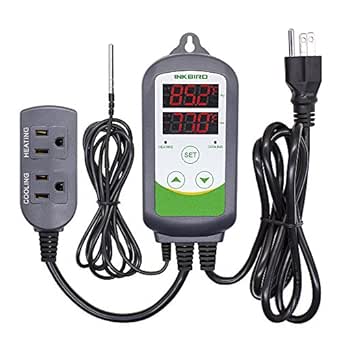
Inkbird ITC-308 Digital Temperature Controller 2-Stage Outlet Thermostat Heating and Cooling Mode Carboy Homebrew Fermenter Greenhouse Terrarium 110V 10A 1100W
This popular model offers the flexibility of both heating and cooling modes, supporting up to 1100W and 10A, making it suitable for fermenters, terrariums, or greenhouses that require precise temperature regulation. Its dual relay system allows independent control of heating and cooling devices, surpassing single-mode controllers like the BN-LINK Cooling Thermostat. The user-friendly LCD display supports °C/°F, and the device includes high and low temperature alarms for added safety. Still, its maximum wattage of 1100W may be limiting for larger systems, and its simple push-button interface lacks advanced features like timers or calibration. Its focus on dual-stage control makes it a versatile choice for hobbyists but less ideal for complex automation setups. Best for small-scale applications requiring both heating and cooling with straightforward operation, but not for large or highly automated environments.
Pros:- Supports both heating and cooling modes
- Easy-to-read LCD with °C/°F support
- High and low temperature alarms for safety
- Simple push-button interface
Cons:- Limited to 1100W maximum load
- No timer or calibration features
- Basic interface may lack advanced automation
Best for: Homebrewers, terrarium enthusiasts, or small greenhouse operators needing dual heating and cooling control.
Not ideal for: Large-scale operations or users seeking advanced features like timers or remote app control.
- Controller Type:Push Button
- Additional Features:Dual Relay, Alarm
- Temperature Range:Supported via user setting
- Wattage:1100W
- Control Method:LCD, Push Button
- Voltage:110V
Bottom line: Best suited for small-scale, dual-mode temperature regulation with straightforward controls.
Attic Fan Thermostat-Control, Adjustable Thermostat with Overload Protector, Temperature Controlled Attic Fan, with Socket Easy to Install, Exhaust Fan Temperature Controller for Workshop, Greenhouse
This thermostat offers a simple, plug-and-play design with an external socket for quick installation, ideal for controlling attic or greenhouse exhaust fans. Its precise temperature regulation within 60-120°F ensures your ventilation system activates only when needed, helping to improve energy efficiency. Compared to the more feature-rich Digital Temperature Controller, it lacks timer and calibration functions but compensates with ease of use and straightforward setup. Its overload protector enhances safety, and the durable alloy steel casing promises long-term reliability. However, the maximum wattage of 1600W might be limiting for larger fans, and its manual control method may not suit those who want remote or automated control. Ideal for homeowners or hobbyists seeking a reliable, easy-to-install attic fan thermostat, but not for complex automation needs.
Pros:- Plug-and-play installation with external socket
- Supports temperature regulation 60-120°F
- Overload protection for safety
- Durable alloy steel casing
Cons:- Limited to 1600W maximum load
- No timer or calibration functions
- Manual control may be less flexible
Best for: Homeowners or greenhouse growers needing a simple, reliable fan control without complex features.
Not ideal for: Users requiring remote operation, timers, or calibration features for precise automation.
- Controller Type:Plug-in
- Additional Features:Overload Protector
- Temperature Range:60°F – 120°F
- Load Capacity:1600W
- Control Method:Manual
- Mounting Type:Plug-in
Bottom line: Best for users who want quick, reliable attic or greenhouse fan control with minimal setup effort.
Inkbird ITC-308 Digital Temperature Controller 2-Stage Outlet Thermostat Heating and Cooling Mode Carboy Homebrew Fermenter Greenhouse Terrarium 110V 10A 1100W
This highly popular model supports both heating and cooling modes with a maximum load of 1100W, making it suitable for fermenters, terrariums, or greenhouses that need precise, simultaneous temperature regulation. Its dual relay system allows independent control of heating and cooling devices, outperforming single-mode controllers like the BN-LINK. The LCD supports °C/°F, and high/low alarms improve safety, but the 1100W wattage limits larger setups. Its simple push-button operation is intuitive, but the lack of timer or calibration features may be a downside for advanced automation requirements. Its focus on dual-stage control makes it a versatile choice for hobbyists, yet not ideal for highly automated systems. Perfect for small-scale applications requiring reliable dual heating/cooling with straightforward operation, but less suited for large or complex environments.
Pros:- Supports both heating and cooling modes
- High/low alarms for safety
- Supports °C/°F display
- Simple push-button operation
Cons:- Limited to 1100W maximum load
- No timer or advanced calibration
- Basic interface for automation enthusiasts
Best for: Homebrewers, terrarium enthusiasts, or small greenhouse operators needing dual-stage, reliable control.
Not ideal for: Large systems or users seeking advanced automation with timers and extensive calibration.
- Controller Type:Push Button
- Additional Features:Dual Relay, Alarm
- Temperature Range:Supported via user setting
- Wattage:1100W
- Control Method:LCD, Push Button
- Voltage:110V
Bottom line: Ideal for small-scale, dual-mode temperature control where ease of use and safety are priorities.
Pymeter Digital Temperature Controller Dual Probe Reptile Thermostat Controlled Outlet for Terrarium Heat Mat Heating Pad, Switch Cooling Fan Freezer Fridge ON & Off at Setpoints 10A 1200W
This dual-probe thermostat stands out for its ability to independently control two zones, making it ideal for managing separate heating and cooling areas in a greenhouse. Unlike simpler single-probe models, it supports both heating and cooling modes on each outlet, providing precise temperature regulation. The waterproof sensors enable reliable operation in humid environments, and its adjustable alarms add a layer of safety. Compared with the WH2408, which offers basic on/off control, this unit offers more flexibility but adds complexity, which might overwhelm beginners. The tradeoff is a slightly steeper learning curve for those unfamiliar with dual-zone thermostats. Overall, this product is best suited for growers needing detailed zone management who can handle its setup intricacies.
Pros:- Independent control of two zones with separate sensors
- Supports both heating and cooling functions per outlet
- Waterproof sensors suitable for humid environments
- High and low temperature alarms for safety
Cons:- Complex setup process may challenge new users
- Requires understanding of temperature differential and alarm settings
Best for: Greenhouse growers who require independent control of multiple zones with high accuracy
Not ideal for: Beginners or hobbyists who prefer simple, plug-and-play thermostats without adjustable alarms or dual sensors
- Controller Type:Dual Probe, Digital
- Max Power:1200W
- Amperage:10A
- Sensors:Dual waterproof probes
- Control Modes:Heating and Cooling
- Additional Features:High/Low alarms, Differential alarm
- Display:LED
- Power Source:120V AC
Bottom line: This thermostat excels for experienced growers needing precise, multi-zone climate control who are comfortable with more detailed setup.

How We Picked
I evaluated these thermostats based on key factors that influence their effectiveness for greenhouse heat and fan control. Performance accuracy, reliability, and durability were primary considerations, ensuring that each device maintains stable temperatures. Usability, including setup complexity and interface clarity, was also important, especially for users with varying technical skills. Value for money and feature set—such as WiFi connectivity, digital displays, and multiple control modes—helped distinguish top choices. Products were ranked by how well they meet the needs of different growers, from beginners to advanced users, ensuring a diverse range of options.Factors to Consider When Choosing Best Dual Outlet Thermostats For Greenhouse Heat And Fans
Choosing the best dual outlet thermostat for your greenhouse requires considering several factors that impact performance and usability. It’s important to match the thermostat’s capacity to your heating and cooling devices, and to evaluate features like digital controls, connectivity options, and build quality. Understanding these considerations helps prevent common mistakes, such as underestimating power needs or selecting overly complex models that are hard to operate. Let’s explore the key factors to keep in mind when selecting a thermostat that will reliably manage your greenhouse environment.Power Capacity and Current Rating
Ensure the thermostat’s maximum load capacity matches or exceeds the combined wattage of your heat and fan devices. Overloading can cause failure or safety hazards. Most models in this roundup support up to 15A or 1800W, suitable for typical greenhouse setups, but verify your equipment’s power draw before purchasing. Selecting a thermostat with a higher capacity than needed can provide extra safety margin but may come at a higher cost or larger size.
Control Features and Usability
Look for digital displays, easy-to-set temperature ranges, and clear interface controls. Some models include programmable schedules or cyclic timers, which add flexibility for maintaining stable conditions. For those less comfortable with technology, simple manual controls might be preferable, while advanced growers might value app integration or WiFi connectivity for remote adjustments. Balancing complexity with usability is key to preventing setup errors and ongoing frustration.
Connectivity and Smart Features
WiFi-enabled thermostats, like the AC Infinity model, allow remote monitoring and control, which can be a significant advantage for busy growers. However, these options tend to be more expensive and may require a stable internet connection and app familiarity. Non-connected models tend to be more straightforward, with fewer points of failure. Decide whether the convenience of smart features outweighs the added cost and complexity for your operation.
Build Quality and Durability
Greenhouse environments can be humid and dusty, so choosing a thermostat with a robust, weather-resistant build is wise. Look for models with sealed displays and sturdy casings, especially if they will be exposed to moisture or outdoor elements. Cheaper or plastic-framed units might save money upfront but could fail prematurely under harsh conditions. Investing in quality can prevent costly replacements and downtime.
Price and Overall Value
While budget options can work for small or temporary setups, investing in a higher-quality model may pay off through increased reliability, features, and lifespan. Consider your specific needs—if you require advanced control or plan to expand, a more feature-rich model justifies a higher price. Conversely, basic thermostats can suffice for simple needs, but be cautious of models that lack essential safety features or accurate sensors.
Frequently Asked Questions
Can I control multiple devices with a dual outlet thermostat?
Yes, most dual outlet thermostats are designed to control two devices simultaneously, such as a heater and a fan, based on a single temperature setpoint. However, verify each device’s power requirements and ensure the thermostat supports the combined load. Some models also allow independent control or different temperature thresholds for each outlet, providing greater flexibility for managing your greenhouse environment effectively.
Are WiFi thermostats reliable enough for greenhouse temperature control?
WiFi thermostats, like the AC Infinity model, offer convenience through remote access and programming, but their reliability depends on your internet stability and network setup. For critical applications, it’s wise to choose models with local manual controls as a backup. Proper installation and updates can enhance reliability, but be prepared for occasional connectivity issues that might require manual intervention.
What should I consider when choosing a thermostat for large greenhouse setups?
For larger operations, focus on thermostats with higher power capacities, durable construction, and possibly dual-zone or multi-stage control features. These models often include more precise sensors and timers to handle complex environments. Investing in a high-quality, scalable system can prevent overheating or chilling, ensuring consistent conditions across a broader space. Compatibility with existing automation may also be a factor for seamless integration.
Is digital display better than analog controls for greenhouse thermostats?
Digital displays generally offer more precise temperature settings, easier readability, and additional features like timers or programming options. They reduce chances of misreading or misadjusting settings, which is critical in a greenhouse environment. However, simpler analog controls can be more durable and easier to operate for basic needs, but they lack the fine-tuning and advanced options digital models provide.
How important is a built-in safety feature like overload protection?
Built-in safety features such as overload protection are essential, especially when controlling high-wattage devices. They prevent electrical failures, reduce fire risk, and extend the lifespan of the thermostat and connected equipment. Prioritizing safety features is a wise choice to safeguard both your investment and your greenhouse environment, particularly if you operate in humid or variable conditions.