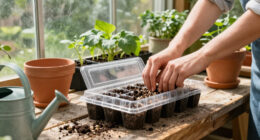
Heated and unheated hothouse seed starting kits both create a sheltered, humid space for seedlings, but they solve different problems. A heated kit adds warmth from below, which can help seeds such as tomatoes, peppers and eggplant germinate in a cool room. An unheated kit costs less and is often enough when the room is already warm or the seeds prefer cooler conditions. The key decision is whether more dependable warmth is worth the added upfront cost and electricity use. Choose heated for cool indoor spaces and heat-loving crops; choose unheated for a warm room, a modest budget or seeds that do not need extra heat.

Get garden gear delivered free with Prime
- Fast, free delivery on millions of items
- Prime Video, Amazon Music and more included
- Member-only deals all year

120-Cell Self-Watering Seed Starter Tray with Grow Light
- ✔ Brand: Patigrow
- ✔ Model: SWSST-L60
- ✔ Cell count: 120

Patigrow 60-Cell Self-Watering Seed Starter Tray with Grow Light and Humidity Dome
- ✔ Brand: Patigrow
- ✔ Model: SWSST-L60
- ✔ Capacity: 60 cells

SOLIGT 60-Cell Seed Starter Tray Kit with Grow Light and Heat Mat
- ✔ Brand: SOLIGT
- ✔ Cell count: 60
- ✔ Grow light power: 11.5 W
At a Glance
| Criteria | Heated hothouse seed starting kits | Unheated hothouse seed starting kits | Winner |
|---|---|---|---|
| Germination warmth | Built-in heat mat warms the tray or growing medium; exact temperatures vary by model. | No active heat; temperature follows the room and surrounding conditions. | A |
| Suitable seeds | Useful for many warm-season crops, including tomatoes, peppers and eggplant. | Works well for seeds suited to the available room temperature and for starts in warm spaces. | Depends |
| Upfront cost | Usually costs more because it includes a heating element and controls. | Usually the less expensive option, with fewer electrical parts. | B |
| Operating cost | Uses electricity while heating; consumption depends on the model and operating time. | No heating electricity; lighting, if included, still uses power. | B |
| Temperature control | Some kits have a thermostat or adjustable control; basic versions may offer limited control. | No built-in temperature adjustment; growers rely on room conditions. | A |
| Setup and maintenance | Requires access to power and attention to tray moisture and heat settings. | Simple to set up, with fewer parts and no heating control to manage. | B |
| Best growing conditions | Cool rooms or early starts where ambient warmth is unreliable. | Warm rooms, mild conditions or seeds that do not need bottom heat. | Depends |
120-Cell Self-Watering Seed Starter Tray with Grow Light
When we want to start a wide range of seeds in one indoor setup, 120 cells make this Patigrow the most capacious choice in the group. Its self-watering base is designed to maintain moisture without relying on frequent top watering, while the humidity dome and adjustable vents let us manage the covered environment as seedlings develop. The 56-bead LED grow light per tray adds a dedicated light source when a suitable bright window is unavailable.Compared with Patigrow’s 60-cell model, the key advantage is simply room for a larger sowing batch; both are described with self-watering, a light, and humidity control. That extra capacity comes with a real space cost: the listed dimensions are 11 by 16.6 inches, and the full setup needs a stable indoor surface and electricity. Unlike the SOLIGT, it does not list a heat mat, so buyers seeking built-in warmth should consider that model instead. This is our strongest all-round pick for volume, provided we can accommodate its footprint.
Pros:
- 120-cell capacity supports a larger sowing batch.
- Self-watering system is intended to help maintain consistent moisture.
- LED light, humidity dome, and adjustable vents are included.
- BPA-free PET construction is specified.
Cons:
- The listed footprint may not suit a narrow windowsill or crowded counter.
- The grow light requires access to electricity.
- No heat mat is listed among the included features.
Best for: Indoor gardeners starting many varieties or a larger seasonal batch who want self-watering and integrated lighting.
Not ideal for: Small-space growers, people relying only on natural light, or anyone who specifically wants an included heat mat.
Bottom line: We recommend this Patigrow for larger indoor starts when its 120-cell capacity and self-watering setup matter more than compactness or built-in heat.
“We recommend this Patigrow for larger indoor starts when its 120-cell capacity and self-watering setup matter more than compactness or built-in heat.”
Patigrow 60-Cell Self-Watering Seed Starter Tray with Grow Light and Humidity Dome
This 60-cell Patigrow suits a more measured sowing plan while retaining the central features of its larger sibling: self-watering, LED lighting, and adjustable humidity vents. The capillary mat draws water from the base, a setup intended to reduce the need for repeated top watering. That can be useful when we are tending herbs, flowers, and vegetables together and want moisture management built into the tray.Compared with the 120-cell Patigrow, this version halves the listed capacity, but the supplied dimensions are nearly identical. We should not assume it occupies half the counter space; the advantage is fewer cells to fill and manage, rather than a clearly smaller overall unit. Its included stand, labels, and gardening tools round out the kit, though assembly is required and the indoor-only design limits where it can be used. The SOLIGT is the better fit if we want a heat mat in the box; this Patigrow makes more sense when self-watering and a moderate batch size take priority.
Pros:
- Capillary mat and base support the self-watering setup.
- LED system includes adjustable brightness and timer functions.
- Adjustable vents allow humidity and airflow to be managed.
- Includes a stand, labels, and gardening tools.
Cons:
- Its listed dimensions are close to the 120-cell model despite having fewer cells.
- Multiple components require assembly.
- Indoor-only use and electrical lighting limit placement options.
Best for: Growers starting a moderate number of indoor seedlings who want capillary watering, a light, and humidity adjustment in one kit.
Not ideal for: Gardeners needing a compact footprint, outdoor use, or built-in bottom heat.
Bottom line: We favor this 60-cell Patigrow when we want the self-watering features of the 120-cell option in a smaller sowing batch, without expecting a much smaller tray.
“We favor this 60-cell Patigrow when we want the self-watering features of the 120-cell option in a smaller sowing batch, without expecting a much smaller tray.”
SOLIGT 60-Cell Seed Starter Tray Kit with Grow Light and Heat Mat
SOLIGT takes a different route from both Patigrow kits by pairing its 60-cell tray with a waterproof heat mat as well as a full-spectrum grow light. That combination makes it the standout choice for growers who want heat included as part of the covered setup, rather than buying a separate mat. Its light has five brightness levels and four timer settings, and the dome vents can be adjusted to manage airflow as conditions change.Compared with the Patigrow 60-cell model, SOLIGT offers built-in heat but does not list a self-watering base or capillary mat. We should therefore expect to manage watering more directly. Its cell dimensions and fixed 60-cell layout suit a defined batch, but provide less room than the 120-cell Patigrow for starting many varieties. The kit also needs outlet access for both the light and heat mat. For buyers prioritizing a warmth-and-light bundle, those tradeoffs may be reasonable; for reduced watering upkeep or maximum capacity, Patigrow is the more aligned choice.
Pros:
- Includes a waterproof heat mat alongside the grow light.
- Light has five brightness levels and four timer settings.
- Adjustable dome vents and drainage holes support environmental management.
- Flexible light positioning accommodates the tabletop setup.
Cons:
- No self-watering system or capillary mat is listed.
- Fixed 60-cell capacity limits larger sowing plans.
- Heat mat and grow light both require electrical access.
Best for: Indoor growers who want a heat mat and adjustable full-spectrum lighting included with a covered 60-cell tray.
Not ideal for: People who prioritize self-watering, need more than 60 cells, or lack convenient outlet access.
Bottom line: We choose SOLIGT when included heat is the deciding feature, accepting more hands-on watering and a fixed 60-cell capacity.
“We choose SOLIGT when included heat is the deciding feature, accepting more hands-on watering and a fixed 60-cell capacity.”
As an Amazon Associate we earn from qualifying purchases.
Key Differences
The practical difference is control over root-zone warmth. A heated kit can raise the temperature around seeds when the room itself is chilly, which may make germination more dependable for warmth-loving crops. It cannot compensate for poor seed quality, unsuitable moisture or incorrect temperatures, and the heat setting should match the seeds being started. An unheated kit offers shelter and humidity without changing the temperature; in a warm room, that may be all the help seeds need.
That difference also shapes value. The heated option costs more to buy and adds electricity use, so its premium makes sense when cold conditions would otherwise delay or prevent germination. In a consistently warm space, paying extra may bring little benefit. Neither type replaces suitable lighting once seedlings emerge: a covered kit can help with germination, but seedlings still need adequate light and airflow as they grow.
Detailed Comparison
Germination warmth (Heated hothouse seed starting kits wins — major)
Heated kits win; the gap is major when the room is cool and minor when it is already warm. Their heating element warms the growing medium, where seeds germinate. That can make early sowing more practical for heat-loving crops. Unheated kits follow ambient conditions, so results may be slower or less consistent in a chilly room. In a warm location, both can provide suitable conditions.
Suitable seeds (moderate difference)
Neither wins for every seed; the difference depends on the crop. Warm-season vegetables often benefit from the added heat in a cool space, while some seeds germinate well at cooler temperatures and may not need it. Follow the seed packet’s temperature guidance. Bottom heat is useful only when it moves conditions toward the seed’s preferred range.
Upfront cost (Unheated hothouse seed starting kits wins — moderate)
Unheated kits win; the gap is moderate. They omit the heating element and sometimes its controller, which generally keeps the purchase price lower. The extra cost of a heated kit is easier to justify if warmth is a genuine barrier to starting seeds. If the room is warm, that premium may not improve results enough to warrant it.
Operating cost (Unheated hothouse seed starting kits wins — minor)
Unheated kits win; the gap is minor to moderate. They do not draw electricity for warmth. Heated kits use power while the element runs, though actual cost varies with wattage, room temperature and how long heating is needed. For a small tray used for a short period, the difference may be modest; frequent or extended use adds up.
Temperature control (Heated hothouse seed starting kits wins — moderate)
Heated kits win; the gap depends on the model. A thermostat or adjustable control can help maintain suitable warmth, but not every kit includes one. Basic heating mats may provide limited control, so check the product details and monitor conditions. Unheated kits provide no temperature adjustment; the grower must choose a suitable location and time for sowing.
Setup and maintenance (Unheated hothouse seed starting kits wins — minor)
Unheated kits win; the gap is minor. They need no power connection or heat setting, making them straightforward to place and use. A heated kit adds a cable and perhaps a control to manage, and the grower must avoid overheating or letting the growing medium dry out. Both types need attention to moisture, ventilation and light as seedlings develop.
Best growing conditions (major difference)
The winner depends on the room. Heated kits have a major advantage in cool spaces where seeds need warmth. In a warm room, an unheated kit can provide the same sheltered starting environment without extra cost or electricity. Consider the temperature where the kit will sit, not just the season outdoors.
Heated hothouse seed starting kits: Pros and Cons
Pros:
- Adds warmth to the growing medium in a cool room.
- Can support more reliable starts for warmth-loving seeds.
- Some models provide thermostat control.
Cons:
- Higher purchase price than a comparable unheated kit.
- Uses electricity while heating.
- Requires attention to temperature and moisture; heat can be unhelpful for seeds that prefer cooler conditions.
Unheated hothouse seed starting kits: Pros and Cons
Pros:
- Usually less expensive to buy.
- No electricity use for heating.
- Simple setup with fewer parts to manage.
Cons:
- Cannot warm seeds when the room is too cool.
- Germination conditions depend on ambient temperature.
- May limit early starts for heat-loving crops in a cold space.
Who Should Choose What
Choose Heated hothouse seed starting kits if:
- Your seed-starting room is cool and you plan to grow tomatoes, peppers or other warmth-loving crops.
- You want more control over germination warmth and the kit has a suitable thermostat or temperature control.
- You start seeds early enough that seasonal room temperatures would otherwise slow germination.
Choose Unheated hothouse seed starting kits if:
- Your indoor space is consistently warm enough for the seeds you plan to start.
- You want a simple, lower-cost kit and do not need extra warmth.
- You are starting seeds that germinate well under your room’s natural conditions.
Skip both if: Skip both if you cannot provide suitable light and airflow after germination, or if your available growing area cannot meet the seeds’ temperature and space needs.
Value for Money
Paying more for a heated kit is worthwhile when cool room temperatures are likely to hold back the seeds you want to start. In that situation, the added warmth can make an earlier or more dependable start possible. The premium buys a tool for managing one specific growing condition, and it is best spent on a model with temperature control suited to your needs. If your room is already warm, the unheated kit is usually the better value: it provides a covered starting space without a heating premium or ongoing heat use. Compare the actual features and energy draw, since kit contents and controls vary.
Final Verdict
Choose a heated hothouse seed starting kit if your room runs cool and you want to start warmth-loving crops; its added control addresses a real obstacle. Choose an unheated kit if your space is warm, your seeds suit ambient conditions or keeping costs down matters most. The deciding factor is the temperature where the kit will sit. For most growers with a reliably warm indoor spot, the unheated kit is the better value. Pay more for heat only when room conditions make that extra warmth useful.
Frequently Asked Questions
Do hothouse seed starting kits need a heat mat?
No. A heat mat is useful when seeds need warmer conditions than your room provides. If the room is already warm enough for the seeds, an unheated kit may be sufficient. Check the seed packet for its preferred germination temperature.
Can a heated kit be too warm for seeds?
Yes. Seeds have different temperature ranges, and excess heat can reduce germination or dry the growing medium. Use a thermostat when available, follow the seed’s temperature guidance and monitor moisture.
Are unheated seed starting kits good for tomatoes and peppers?
They can work if the room is warm enough. In a cool room, bottom heat may help those warmth-loving crops germinate more reliably. The kit itself does not replace suitable light once seedlings emerge.
Is the added cost of a heated kit worth it?
It is worth paying more when cool indoor conditions make germination difficult or slow for your chosen seeds. If your growing space is already warm, an unheated kit is usually the more economical choice.
Evergreen bestsellers Picks

Ninja Foodi DualZone Smart XL Air Fryer, 10-Quart, 6-in-1, Black, DZ550

Samsung S85H 48-Inch 4K OLED Smart TV (2026)

Dyson V12 Detect Slim Absolute Cordless Stick Vacuum
As an affiliate, we earn on qualifying purchases.