TL;DR

Get garden gear delivered free with Prime
- Fast, free delivery on millions of items
- Prime Video, Amazon Music and more included
- Member-only deals all year
A Homes & Gardens report says five newly planted evergreens—arborvitae, boxwood, rhododendron, Japanese holly and yew—may need extra care during their first winter. Its guidance includes watering during dry fall weather, mulching without covering stems or crowns, and using breathable wind screens at exposed sites.
A Homes & Gardens report identifies five evergreens that may need extra protection during their first winter: arborvitae, boxwood, rhododendron, Japanese holly and yew. The advice matters because newly planted roots may not yet reach enough soil to replace moisture lost from foliage to winter sun and drying winds, particularly when the ground is frozen.
The report recommends checking soil moisture during dry fall weather and giving new plants a slow, deep watering before the ground freezes. It advises applying mulch over the root zone to help moderate soil moisture and temperature, while keeping mulch away from trunks and, for rhododendrons, leaving the crown clear. Rhododendrons also need soil that drains freely; they should not be left waterlogged.
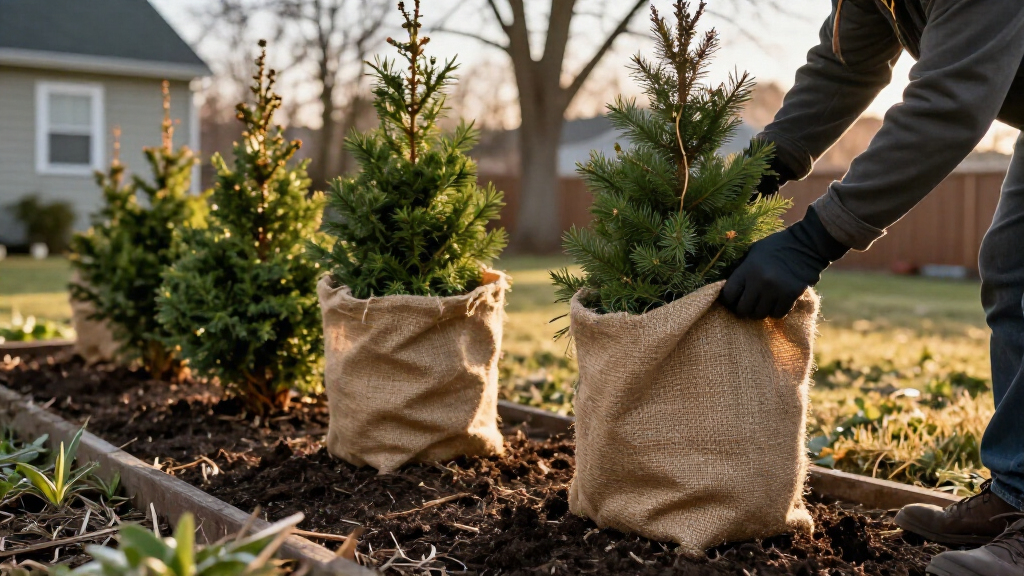
At sites exposed to prevailing winds, the report suggests a breathable burlap screen on the windward side rather than tightly wrapping the whole plant. It says screens should leave room for air movement and should not press fabric against foliage. For arborvitae with loose or multiple leaders, soft ties may help limit branch splaying under heavy, wet snow, but should not be tightened around branches.
The recommendations vary with the plant and its location. Container-grown boxwood may need a sheltered position and insulation around the pot because its roots face faster temperature swings than roots in the ground. Japanese holly hardiness depends on cultivar and local conditions, the report says; its end plants in a row may be more exposed to wind. For yew, the source emphasizes that hardiness after establishment does not remove the vulnerability of a recently planted shrub.
Why First-Winter Root Care Matters
The guidance focuses on a vulnerability that can be missed when a plant is described as hardy: established-plant hardiness is not the same as first-year resilience. Until roots spread into surrounding soil, a new evergreen may have limited access to water just as its foliage continues losing moisture. Cold weather, frozen ground and wind can combine to make that imbalance harder to correct.
For homeowners, the practical implication is to treat fall watering and site exposure as part of planting care, rather than assuming evergreen leaves mean a shrub can manage without attention. A wind screen is suggested only where exposure warrants it, and water needs to be balanced with drainage, especially for rhododendrons. These measures may reduce stress, but the report does not promise that they will prevent all winter damage.
Products Worth Considering

EGO POWER+ 21 Cordless Electric Lawn Mower Kit, Self-Propelled

Orbit B-hyve XR Smart Indoor/Outdoor Sprinkler Controller, 16 Zones

Solo Stove Bonfire 2.0 Smokeless Wood-Burning Fire Pit with Stand, Silver
As an affiliate, we earn on qualifying purchases.
How the Five Shrubs Differ
The report covers plants often used for privacy, formal borders and evergreen structure. Arborvitae can develop winter burn when foliage loses moisture, with taller, narrow forms singled out as potentially vulnerable while roots establish. Newly planted boxwood can also face drying winds; exposed sites may add the risk of foliage scorch from sun and temperature swings.
Rhododendrons have broad evergreen leaves and shallow roots, making a sheltered location and suitable, well-drained soil relevant to winter care. Japanese holly is often used as a boxwood alternative, but the report cautions that its cold tolerance varies by cultivar and local conditions. Yew is described as adaptable once settled, but a newly planted specimen has a smaller root system than an established one. Across all five, local climate, planting conditions and exposure affect how much protection is needed.
“In their first winter, even hardy evergreens can struggle because their roots have not spread far enough to replace moisture lost to cold, sun, and drying winds.”
— Homes & Gardens report
Local Conditions Shape Protection Needs
The report does not give a single watering volume, a fixed date for installing screens, or a uniform cold threshold for all five plants. Those needs depend on weather, soil drainage, exposure, plant size and local hardiness. Japanese holly varieties in particular can differ in cold tolerance, and the source advises checking the plant label and matching the cultivar to local conditions.
It also does not quantify how much a wind screen or mulch reduces winter damage, or guarantee survival after the suggested steps. A frost cover is described as an option for brief freezes on small Japanese holly, but the report says to remove it during mild spells rather than leave the shrub sealed in. Gardeners should make decisions based on actual conditions and the plant’s requirements.
Fall Checks Before Ground Freezes
As fall turns colder, gardeners can check whether newly planted evergreens have received enough water during dry spells, confirm that mulch is not piled against stems or crowns, and identify plants exposed to prevailing winds. Where a screen is needed, the report recommends breathable fabric supported by stakes, with ties checked after storms so they do not rub or tighten around stems.
For container plants, the next step is to move them to a sheltered spot and protect the pot as temperatures fall. The report gives October as a time to water deeply during dry spells, but its advice is conditional rather than a fixed schedule: soil should be moist, not waterlogged, and conditions vary. The level of protection needed through winter will become clearer as local weather and site exposure change.
Key Questions
Which newly planted evergreens does the report name?
It lists arborvitae, boxwood, rhododendron, Japanese holly and yew as evergreens that may need winter protection after planting.
When should I water a new evergreen before winter?
The report recommends deep watering during dry fall spells, including in October, and before the ground freezes. Check that the soil drains well; rhododendrons should not sit in waterlogged soil.
Should I wrap an evergreen in burlap?
The report favors a breathable wind screen on the exposed side where needed, rather than tightly wrapping the whole plant. Fabric should allow airflow and should not press against foliage.
How should I mulch a newly planted evergreen?
Spread mulch over the root zone to help moderate moisture and soil temperature, but keep it several inches from trunks. For rhododendrons, leave the crown clear.
Do all cultivars need the same winter protection?
No. The report says protection depends on cultivar, local climate, drainage and exposure. Check the plant label, especially for Japanese holly, whose cold tolerance varies.
Source: rss