
TL;DR

Get garden gear delivered free with Prime
- Fast, free delivery on millions of items
- Prime Video, Amazon Music and more included
- Member-only deals all year
Crocus corms are adapted to cold and need a winter chilling period to flower. The source report says they can withstand temperatures well below freezing, while snow can help insulate them; gardeners should plant corms in fall, not winter.
Crocuses can grow in cold climates, and their corms can survive deep winter freezes, according to a report from Gardener’s Path. The flowers need a sustained period of cold to bloom, while snow can insulate the corms in the soil; the report advises planting them in fall rather than winter.
The report says snow crocus (Crocus chrysanthus) and Dutch crocus (C. vernus) can be grown in USDA Hardiness Zones 3 to 8. It describes crocuses as suited to sunny sites with well-drained soil and says most corms should be planted six to eight weeks before the first frost, giving them time to establish before winter.
Crocuses need a prolonged cold period to flower. The report says their corms require about four months at soil temperatures of 35°F or below. Without sufficient chilling, plants may still grow, but their leaves and flowers can be weak or stunted. For gardeners in Zone 9, the report describes refrigerating corms for at least four months before planting them in spring.
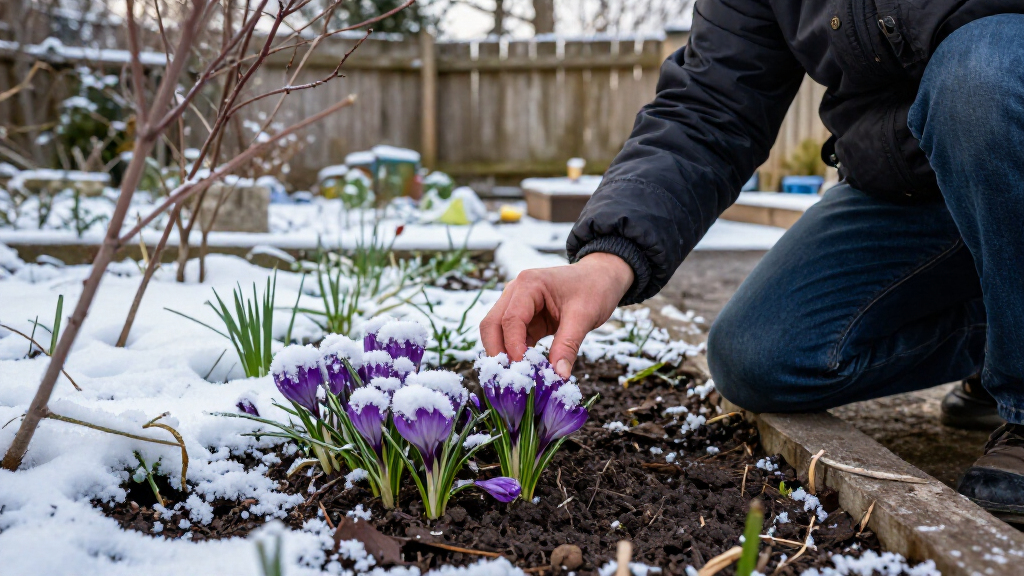
Cold well below freezing does not, by itself, mean the corms will die. The article says crocuses can tolerate temperatures far below 35°F, including the extreme cold associated with Zone 3. In Zones 3 and 4, it recommends planting corms four inches deep rather than three to add insulation. The article also says snow can help prevent corms from drying out and that blooms may emerge through late-winter snow.
Winter Cold Sets Up Spring Blooms
For gardeners in cold regions, the key point is that winter is part of the crocus’s growing cycle, not simply a period the plant must endure. A suitable cold spell helps prepare the corm to flower, so attempting to shield crocuses from ordinary winter conditions may work against what they need. Snow cover can provide insulation, rather than being an automatic threat to the planting.
The guidance also gives gardeners a practical planting window. Corms need to be in the ground well before the first frost, and planting them in winter is too late to provide the establishment time described in the report. That distinction matters for anyone hoping to add early color to a lawn or garden: preparation happens in fall, while the visible payoff comes after winter.
These recommendations are general gardening guidance, not a guarantee for every site. Drainage, local conditions and the actual temperature around the corm can affect results. Still, the report’s central message is useful for cold-climate gardeners: freezing conditions are compatible with crocuses, and the right period of cold supports flowering.
Products Worth Considering

Rachio 3 Smart Sprinkler Controller, 16 Zones

Husqvarna 460 Rancher Gas Chainsaw, 24-Inch Bar

Greenworks 80V Cordless Electric Leaf Blower, 700 CFM, with 2.5 Ah Battery and Charger
As an affiliate, we earn on qualifying purchases.
How the Crocus Uses Winter
The report explains that a crocus grows from a corm, an underground storage structure. After summer dormancy, falling soil temperatures prompt the corm to resume root and shoot growth. When soil becomes cold enough, it enters a resting period. The article says that this cold response is part of the plant’s preparation for spring bloom.
Its account draws on a 2015 paper by Helmut Kerndorff, Erich Pasche and Dörte Harpke, published in the Austrian botanical journal Stapfia, as well as information from the Netherlands Bulb Council published in Texas A&M University’s Horticulture Update. The report describes a new daughter corm forming as the plant flowers, eventually replacing the original corm.
The article says crocus flowers can appear quickly when conditions become favorable, sometimes seeming to emerge between one day and the next. That does not mean a corm should be planted in winter: the recommended schedule is to plant in fall and let the plant pass through its seasonal cycle in place.
“The insulation from the earth helps keep the corm cozy and moist, until temperatures warm back up just enough for the plant to quickly push its flowers and leaves up into chilly springtime lawns.”
— Gardener’s Path report, citing the Netherlands Bulb Council
Local Conditions Still Matter
The report gives general temperature, planting-depth and timing guidance, but it does not establish how every crocus variety will perform in every garden or under every pattern of snow cover. Local soil drainage and winter conditions can differ, and the article does not provide a site-by-site planting assessment or experimental results comparing corm survival.
The article also does not specify how long a snow cover must last to insulate a planting, or how repeated thawing and freezing might affect corms in particular soils. Its hardiness-zone guidance should not be read as a guarantee that every planting will flower. Gardeners should check local growing conditions and follow supplier instructions for the varieties they buy.
Plant Corms Before Frost
For a spring display, the report’s next step is to plan ahead and plant corms in fall, six to eight weeks before the first frost. Choose a sunny, well-drained location and use the deeper four-inch planting depth recommended for Zones 3 and 4. Once planted, the corms can experience the cold period the article says they need.
Gardeners who have missed the fall window should wait to plant rather than placing corms outdoors in winter. The report describes a refrigerator chilling period for Zone 9 gardeners before spring planting, but it does not give detailed instructions for storage conditions. Buyers should check guidance from their corm supplier and local extension services for advice suited to their region.
Key Questions
Can crocus corms survive snow and freezing temperatures?
Yes, according to the report. Crocus corms can survive deep freezes, and snow can help insulate them and limit drying. Survival and flowering can still depend on local soil and growing conditions.
How much cold do crocuses need to bloom?
The report says crocuses need about four months in soil at 35°F or below for their cold requirement. Without adequate chilling, flowers and leaves may be weak or stunted.
When should I plant crocus corms?
Plant most corms in fall, six to eight weeks before the first frost, according to the report. It says winter planting is too late for the recommended establishment period.
How deep should crocus corms go in very cold regions?
For Zones 3 and 4, the report recommends planting corms four inches deep, rather than the usual three inches, to provide added insulation.
Can crocuses grow in Zone 9?
The report says they can, if corms are refrigerated for at least four months before spring planting. It does not provide detailed refrigerator-storage conditions, so gardeners should also consult supplier or local gardening guidance.
Source: gardenerspath.com