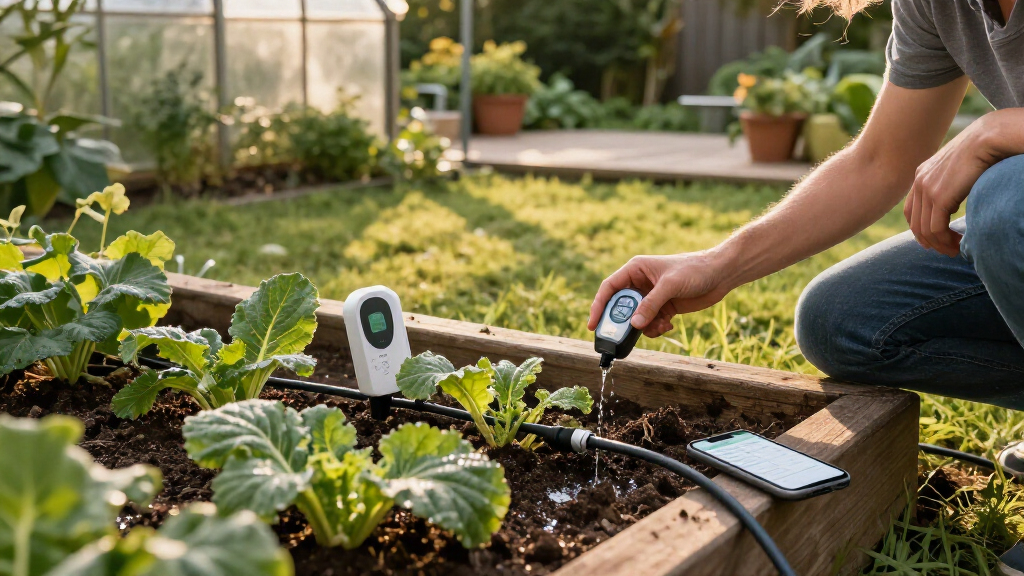

Smart hose timers and smart irrigation controllers both automate garden watering, but they solve different problems. A hose timer attaches to an outdoor tap and runs a hose or drip line on a schedule; a controller operates multiple irrigation zones, often through existing valves and buried or fixed piping. That distinction affects setup, cost, coverage, and how much control you get over different parts of the garden.

Get garden gear delivered free with Prime
- Fast, free delivery on millions of items
- Prime Video, Amazon Music and more included
- Member-only deals all year

HEKIWAY 120 ft Drip Irrigation System with Smart Water Timer
- ✔ Hose length: 120 feet
- ✔ Power: Battery powered; batteries not included
- ✔ Timer: Programmable schedule, 1–15-day rain delay, child lock

HEKIWAY 120 ft Drip Irrigation System with Smart Water Timer
- ✔ Hose length: 120 feet
- ✔ Power: Battery powered; batteries not included
- ✔ Timer: Programmable watering, 1–15-day rain delay, child lock

HEKIWAY 60-Foot Drip Irrigation System with Smart Water Timer
- ✔ Hose length: 60 feet
- ✔ Power: Battery powered; batteries not included
- ✔ Timer: Programmable schedules, 1–15-day rain delay, child lock
For a balcony, small lawn, raised beds, or a few containers, a hose-timer system is usually the practical choice. It takes less installation and can cost less when you need only one or two watering points. A controller makes more sense for a larger property with separate lawn, planting, and drip zones, especially if irrigation plumbing is already in place. The comparison below focuses on what those differences mean in daily use, including the cases where paying more for a controller is justified.
At a Glance
| Criteria | Smart hose-timer systems | Smart irrigation controllers | Winner |
|---|---|---|---|
| Best garden size | Small gardens, patios, containers, and a few beds | Medium to large gardens with established irrigation | Depends |
| Zones and control | Usually one tap per timer; add units for more watering points | Controls multiple zones from a central controller | B |
| Installation | Attaches to a tap; generally a simple setup | May require valve wiring, compatible plumbing, or professional installation | A |
| Scheduling and smart features | Schedules and app control vary by model; some support weather or moisture inputs | Often offers zone schedules and broader system-level controls; features vary | B |
| Watering coverage | Works with hoses, sprinklers, and compatible drip lines | Can manage separate fixed irrigation zones across a property | B |
| Cost and value | Usually lower entry cost for a small setup | Higher upfront cost, with better value when several zones are needed | A |
HEKIWAY 120 ft Drip Irrigation System with Smart Water Timer
For gardeners who need one system to adapt to different planting zones, this 120-foot kit is our most versatile pick. Its bendable tubing and 360° adjustable sprayers make it easier to direct water around raised beds, pots, greenhouse rows, or lawn edges than a fixed-position setup would. Adjustable flow—from a gentle mist to a focused stream—also gives us more control when one area contains plants with different watering needs. The kit includes installation accessories, which helps distinguish its described package from the second 120-foot option, whose listing only specifies a drip irrigation kit.The timer adds useful routine automation: we can program watering and use a 1–15-day rain delay to pause the schedule after wet weather. Child lock is a practical safeguard if the controls are accessible to others. Still, the supplied details describe a battery-powered timer, not a phone-connected controller, so we should choose another category of system if remote scheduling is essential. At 2.02 kg, it is also not the lightest option; the shorter 60-foot kit weighs less and is easier to match to a compact space.Brass connectors, UV-resistant tubing, and reinforced seals are described as outdoor-oriented construction. Those materials are relevant to a system that stays in place, but the listing does not specify a weatherproof rating or quantified service life. We should also budget time for arranging the tubing and aiming each sprayer: adjustability helps tailor the layout, but it does not make installation automatic. Buy this version for reach and layout flexibility; skip it if our garden fits comfortably within 60 feet or if we expect app-based control.
Pros:
- 120 feet of tubing gives more reach for spread-out planting zones.
- Bendable tubing and 360° sprayers allow targeted placement.
- Programmable timer includes a 1–15-day rain delay and child lock.
- Adjustable flow supports gentle misting through a focused stream.
Cons:
- Timer batteries are not included.
- The listing does not specify app control, flow rates, or weatherproof rating.
- Its longer tubing and multiple adjustable sprayers require setup and placement.
Best for: Gardeners covering several beds, pots, or greenhouse areas who want long tubing and adjustable watering points.
Not ideal for: Small patio gardeners with limited planting space, or buyers who require stated phone control and remote monitoring.
Bottom line: We recommend this 120-foot version for mixed, spread-out gardens where flexible routing and adjustable flow matter more than a compact footprint.
“We recommend this 120-foot version for mixed, spread-out gardens where flexible routing and adjustable flow matter more than a compact footprint.”
HEKIWAY 120 ft Drip Irrigation System with Smart Water Timer
This second 120-foot HEKIWAY system covers the same broad-use territory as our top pick, with programmable watering, a rain delay, child lock, bendable tubing, and nozzles that adjust through 360°. Its distinguishing detail is the described combination of brass connectors and dual metal tubes, which the product information characterizes as rust-resistant and pressure-stable. That may appeal to buyers who prioritize those components in their setup, though the listing gives no comparative pressure or durability measurements to show how it performs against the first 120-foot kit.In practical terms, we would decide between these two long kits by looking at the package details and material preference. The B0GBVQ3GTN listing explicitly names installation accessories and UV-resistant tubing with reinforced seals; this version explicitly emphasizes dual metal tubes. Both describe flexible tubing and adjustable nozzles, and both promise flow adjustment from mist to stream. At 2.26 kg, this model is also a little heavier than the other 120-foot option, while the 60-foot kit is substantially lighter for smaller setups.The timer is useful for a recurring schedule and for pausing watering during a rainy stretch, but there is no stated app or smart-home connection. Battery power keeps the system independent of a wired outlet, yet batteries are not included. We should also verify what exactly arrives: its listed included components say only “drip irrigation kit,” which is less specific than the first model’s component list. This is a sensible alternative when the metal-tube description is the deciding factor, but buyers seeking the clearest package breakdown may prefer the top-ranked 120-foot version.
Pros:
- 120 feet of reach for multiple garden areas.
- Programmable watering includes rain delay and child lock.
- 360° adjustable nozzles and flexible tubing help aim coverage.
- Product description highlights brass connectors and dual metal tubes.
Cons:
- Timer batteries are not included.
- At 2.26 kg, it is the heaviest of the three listed kits.
- The included-components specification is less detailed than the first 120-foot model.
Best for: Gardeners who want 120 feet of coverage and place particular importance on the stated brass connectors and dual metal tubes.
Not ideal for: Buyers who want a fully detailed included-parts list, the lightest setup, or confirmed app-based irrigation controls.
Bottom line: We would choose this model over the other 120-foot kit when its stated dual metal tubes are the priority and the less detailed component list is acceptable.
“We would choose this model over the other 120-foot kit when its stated dual metal tubes are the priority and the less detailed component list is acceptable.”
HEKIWAY 60-Foot Drip Irrigation System with Smart Water Timer
When our garden is close to the house, limited to a few raised beds, or arranged across patio containers, 60 feet may be the more useful size. This kit keeps the core automation of the longer models: scheduled watering, a 1–15-day rain delay, and child lock. It also includes flexible tubing and adjustable 360° sprayers, so the shorter length does not mean giving up the basic ability to direct water where it is needed. At 1.19 kg, it is the lightest listed option, which better suits a setup we may reposition or store seasonally.Compared with the two 120-foot kits, the obvious tradeoff is reach. A compact footprint is simpler to plan, but we should map the route from the water source to each bed before choosing it; extending across a larger yard may require more tubing than this kit provides. The timer features are comparable across all three products, so the 60-foot model does not gain a unique automation advantage. Its role is about matching system length to a smaller garden, rather than delivering more control than the long versions.The listing describes brass connectors, UV-resistant tubing, reinforced seals, and adjustable flow for different plants. It does not give exact flow rates, battery life, pressure limits, or a weatherproof rating, so we should avoid treating those details as proven performance measures. Batteries are not included, and manual placement still matters if we want consistent coverage across containers or beds. Choose this model when a shorter run is enough and a lighter kit is appealing; choose either 120-foot version if the watering layout is spread out or likely to expand.
Pros:
- 60-foot length suits smaller garden footprints.
- Lightest listed option at 1.19 kg.
- Timer includes scheduling, rain delay, and child lock.
- Adjustable 360° sprayers and flow help tailor watering.
Cons:
- Shorter reach than either 120-foot alternative.
- Batteries are not included.
- The listing does not specify app connectivity or quantified flow performance.
Best for: Patio gardeners and owners of compact raised beds or greenhouse spaces who need a shorter, lighter tubing run.
Not ideal for: Buyers with spread-out beds, a large lawn, or plans to expand beyond a 60-foot watering layout.
Bottom line: We recommend the 60-foot kit for compact gardens where lighter handling and a right-sized tubing run outweigh the extra reach of the two longer options.
“We recommend the 60-foot kit for compact gardens where lighter handling and a right-sized tubing run outweigh the extra reach of the two longer options.”
As an Amazon Associate we earn from qualifying purchases.
Key Differences
The first decision is how many independent watering areas you need. A hose timer is a compact way to automate water from a tap, but each timer typically controls the outlet it is attached to. You can add more timers, though that means managing separate devices and confirming that the tap and water supply can support the demand. A controller is built for dividing an irrigation system into zones, so it is easier to give a lawn, shrubs, and drip beds different schedules.
That additional control comes with more setup and expense. A timer can be ready to use after attaching it and configuring its schedule. A controller may need wiring to valves, compatible irrigation infrastructure, and a suitable power or network connection. For someone starting with a hose and a few planters, the controller’s extra capacity can go unused. For someone already maintaining several irrigation zones, relying on separate tap timers can become a patchwork that is harder to adjust.
Neither category guarantees lower water use by itself. Good scheduling, suitable emitters or sprinklers, local weather, soil, and plant needs all matter. Smart features can help adjust a schedule, but their availability and accuracy differ by model and region. Check compatibility and the specific features before buying. The better value is the system that fits the existing garden and can water each area appropriately, without paying for capacity or installation you will not use.
Detailed Comparison
Best garden size (major difference)
Smart hose timers suit compact gardens where one or a few taps can reach the plants. They are also a straightforward choice for renters or anyone who does not want to change fixed irrigation. Smart controllers suit properties with several areas that need distinct watering plans. Winner: depends on garden scale. The gap is major when a property has many zones: a timer can serve a small setup well, while multiple separate timers can become cumbersome as coverage grows.
Zones and control (Smart irrigation controllers wins — major)
A hose timer generally controls water from its own tap, so each outlet is managed separately. A controller coordinates multiple zones and can apply distinct schedules to them from one interface. Winner: smart irrigation controllers. The gap is major for multi-zone gardens because central control makes adjustments easier and reduces the need to maintain separate schedules across devices. For a single hose, that advantage has little practical value.
Installation (Smart hose-timer systems wins — moderate)
A hose timer usually attaches between an outdoor tap and a hose, then needs a schedule and any required app setup. A controller may involve existing valves, wiring, and irrigation plumbing; some installations are simple, while others call for an installer. Winner: smart hose timers. The gap is moderate for most households and major where fixed irrigation must be added. The controller’s installation burden is easier to justify when the property already has compatible zones.
Scheduling and smart features (Smart irrigation controllers wins — moderate)
Both categories can offer app-based scheduling, but features depend on the model. Some hose timers provide straightforward schedules and remote operation; certain systems can use weather or soil-moisture inputs. Controllers often provide a more organized view of several zone schedules, with additional adjustments available on some products. Winner: smart irrigation controllers, narrowly. The gap is moderate for a multi-zone setup and minor for a small garden. Buyers should compare the exact weather, sensor, and connectivity features rather than assuming every product in either category has them.
Watering coverage (Smart irrigation controllers wins — major)
A timer can supply a sprinkler, hose, or compatible drip line from a tap, making it useful for a bed or defined area. A controller can run multiple fixed zones across a wider property, provided the plumbing and valves are designed for that coverage. Winner: smart irrigation controllers for broad coverage. The gap is major across lawns and multiple planting areas, but minor if a single tap already reaches the entire garden. Check water pressure and flow: adding outlets does not guarantee that every zone can run effectively at once.
Cost and value (major difference)
Hose timers generally have a lower entry cost and can automate a small garden without the added expense of a central controller or valve work. Controllers cost more upfront, and installation may add to the total. Their price can represent better value when it replaces a collection of timers or manages several existing zones. Winner: smart hose timers for small gardens; controllers for established multi-zone systems. The difference is major if installation is needed and moderate when compatible infrastructure is already present.
Smart hose-timer systems: Pros and Cons
Pros:
- Simple attachment to an outdoor tap in many setups
- Lower starting cost for one or a few watering points
- Useful for containers, raised beds, and hose-fed drip lines
- Can suit renters or gardens without fixed irrigation
Cons:
- Each timer typically manages a separate tap or outlet
- Several units can mean separate schedules and app controls
- Coverage depends on tap access, hose routing, and water flow
- Advanced weather or sensor features vary by model
Smart irrigation controllers: Pros and Cons
Pros:
- Central control for several irrigation zones
- Can assign separate schedules to different garden areas
- Well suited to fixed lawn and planting-bed irrigation
- May make a larger existing system easier to manage
Cons:
- Higher purchase cost than a basic hose timer
- May require compatible valves, wiring, and irrigation plumbing
- Installation can be more involved or require a professional
- Extra capacity offers little benefit in a small, single-tap garden
Who Should Choose What
Choose Smart hose-timer systems if:
- You water a balcony, patio, containers, or a small number of beds from an outdoor tap.
- You want scheduled hose or drip-line watering with minimal installation.
- You rent or do not have fixed irrigation valves and piping.
- You want to automate one or two watering points without paying for a multi-zone system.
Choose Smart irrigation controllers if:
- Your garden has several zones, such as lawn, shrubs, and separate planting beds.
- You already have compatible irrigation valves and fixed piping.
- You want to manage several zone schedules from one controller.
- The time or effort involved in adjusting separate timers has become a problem.
Skip both if: You water only occasionally and a manual hose is easy to manage, or your garden first needs a reliable water source, suitable irrigation layout, or repaired plumbing before automation will help.
Value for Money
For a small garden, a smart hose timer is usually the better value because it automates the watering task without requiring a multi-zone controller or fixed irrigation work. Paying more for a controller makes sense when you will use its central zone management, particularly if the garden already has compatible valves and piping. If installation costs are substantial, compare the full installed price with the cost of adding suitable timers and lines. A higher price does not by itself mean lower water use: that depends on schedules, local conditions, and how the irrigation is set up.
Final Verdict
Choose a smart hose-timer system for a compact garden that draws water from one or a few taps. It is the clearest fit when easy setup and low upfront cost matter more than coordinating several zones. Choose a smart irrigation controller for a larger garden with multiple distinct watering areas, especially when fixed irrigation is already installed. The biggest deciding factor is the number of zones you need to manage. For one or two simple watering points, start with a timer; for a property-wide system, the controller is usually worth its added cost and setup.
Frequently Asked Questions
Can a smart hose timer control drip irrigation?
Often, yes. A timer can supply a compatible drip line from a tap, but check the product’s connection, pressure, and flow requirements. The drip system also needs suitable tubing and emitters for the plants and layout.
Can I use several smart hose timers in one garden?
Usually, you can add timers at separate taps, subject to the devices and water supply. Each unit may need its own schedule or setup, so several timers are less convenient than a controller when many zones need coordination.
Will either system automatically reduce my water bill?
Neither guarantees savings. Automation can prevent missed shutoffs or unnecessary watering when schedules and adjustments match local weather, soil, and plant needs. Compare actual usage and account for the system’s purchase and installation cost.
Is a smart irrigation controller worth installing in a small garden?
Usually only if the garden has multiple zones or compatible fixed irrigation that you want to manage centrally. For a few containers or one hose-fed bed, a hose timer is generally simpler and costs less.