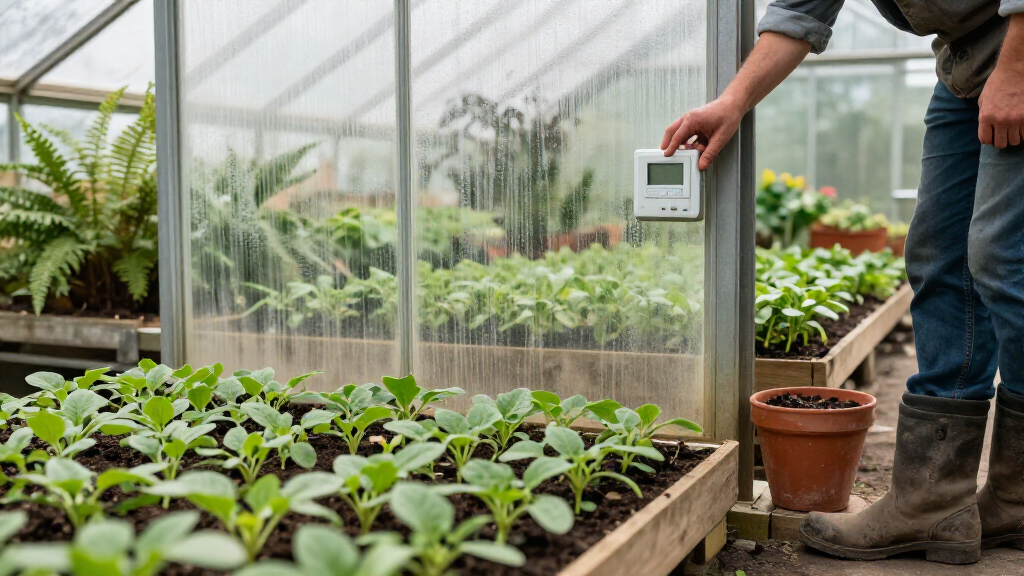

Greenhouse heater thermostats range from heaters with built-in temperature controls to plug-in controllers that manage a separate heater. My best overall pick is the TRUSTECH 1500W Greenhouse Heater for its heater-and-digital-thermostat format; the VIVOSUN AeroFlux 700W stands out for app control and VPD monitoring, while the Inkbird ITC-308 WiFi suits growers who want a separate connected controller. The main tradeoffs are heating capacity, control precision, remote access, and compatibility with your heater and power supply. A built-in thermostat is simpler, while a separate controller offers more flexibility but adds setup checks. Read on for the full comparison and a guide to choosing the right setup for your greenhouse.

Get garden gear delivered free with Prime
- Fast, free delivery on millions of items
- Prime Video, Amazon Music and more included
- Member-only deals all year
Complete the kit


Key Takeaways
- Built-in control is the simplest route: The TRUSTECH, SmterCon, and VEVOR heater listings pair a heater with thermostat control, avoiding the extra wiring and compatibility checks of a separate controller.
- Connected control varies by purpose: The VIVOSUN AeroFlux combines app control with VPD monitoring, while the Inkbird ITC-308 WiFi is a standalone controller for growers who already have a compatible heater.
- Power rating alone does not determine fit: Several options are rated at 1500W, but greenhouse size, insulation, outdoor conditions, and sensor placement shape the temperature a heater can maintain.
- Some listings are duplicates or near-duplicates: The lineup includes two VEVOR 1500W entries and two SmterCon digital-thermostat entries, so buyers should check the exact listing and included accessories rather than assume distinct performance.
- Controller-only products serve different needs than heater bundles: ZILLSEA, DEWENWILS, BN-LINK, and VIVOSUN‘s 1500W controller offer flexible temperature management, but they do not replace the need to select a compatible heater.
| TRUSTECH Greenhouse Heater with Digital Thermostat, 1500W |  | Best Overall for Small Greenhouses | Power: 750W or 1500W | Modes: Low heat, high heat, fan only | Temperature range: 40°F–108°F (5°C–42°C) | VIEW LATEST PRICE | See Our Full Breakdown |
| VIVOSUN AeroFlux 700W PTC Grow Tent Heater with Thermostat, App Control, and VPD Monitoring |  | Best Smart Control for Grow Tents | Power: 700W | Heating method: PTC | Heat levels: 5 | VIEW LATEST PRICE | See Our Full Breakdown |
| 1500W Greenhouse Heater with Thermostat, 2-Pack, Green |  | Best for Multiple Growing Zones | Quantity: 2 heater fans | Power modes: 24W fan-only, 750W low, 1500W high | Power supply: 110V AC / 60Hz | VIEW LATEST PRICE | See Our Full Breakdown |
| SmterCon Greenhouse Heater with Digital Thermostat |  | Best for Simple Automatic Temperature Control | Model: MGP-2 | Power: 1500W | Thermostat: Digital, automatic temperature control | VIEW LATEST PRICE | See Our Full Breakdown |
| VEVOR 1500W Greenhouse Heater with Thermostat |  | Best Compact Manual-Angle Heater | Model: BGP1606-150 | Heating element: PTC ceramic | Heat output: 1500W | VIEW LATEST PRICE | See Our Full Breakdown |
| VEVOR 1500W Greenhouse Heater with Thermostat |  | Best for Adjustable Airflow | Power: 1500 W | Voltage: 120 V | Amperage: 12.5 A | VIEW LATEST PRICE | See Our Full Breakdown |
| GNRZZT Greenhouse Heater with Thermostat, 1500W PTC Ceramic Heater |  | Best for Humid Greenhouses | Heating power: 1500 W | Heat output: 5120 BTU per hour | Thermostat range and accuracy: 41°F–108°F; ±1°F | VIEW LATEST PRICE | See Our Full Breakdown |
| ZILLSEA Digital Temperature Controller with Heating and Cooling |  | Best Standalone Controller | Temperature range: -40°F to 210°F | Stated accuracy: 0.1°F | Maximum load: 15A / 1800W resistive | VIEW LATEST PRICE | See Our Full Breakdown |
| Roodike 1500W Blower Heater with Thermostat |  | Best Compact Pick | Power settings: 1500 W and 750 W | Modes: Three: high heat, low heat, natural fan | Heating coverage: Up to 120 sq. ft. | VIEW LATEST PRICE | See Our Full Breakdown |
| DEWENWILS 15A Temperature Controller Outlet |  | Best for Restoring Settings After Outages | Temperature range: -40°F to 210°F | Temperature precision: 0.1°F | Maximum current and wattage: 15A; 1800W | VIEW LATEST PRICE | See Our Full Breakdown |
| Pasapair 1500W WiFi Greenhouse Heater with Thermostat |  | Best for Scheduled Remote Control | Power: 1500W | Heating method: PTC ceramic | Temperature range: 41°F to 108°F | VIEW LATEST PRICE | See Our Full Breakdown |
| VIVOSUN 1500W Digital Temperature Controller with Heating and Cooling |  | Best for Separate Heating and Cooling Control | Model: TC-0001 | Controller type: Push button | Operating temperature range: -22°F to 167°F | VIEW LATEST PRICE | See Our Full Breakdown |
| BN-LINK Digital Reptile Thermostat Temperature Controller |  | Best Simple Controller for Seedling Heat | Model: T7(H) | Temperature range: 40–108°F | Maximum load: 1000W, 8.3A | VIEW LATEST PRICE | See Our Full Breakdown |
| Inkbird ITC-308 WiFi Temperature Controller |  | Best for App-Based Temperature Alerts | Model: ITC-308-WIFI-LW | Connectivity: 2.4 GHz Wi-Fi | App: InkbirdSmart | VIEW LATEST PRICE | See Our Full Breakdown |
| SmterCon Greenhouse Heater with Digital Thermostat |  | Best for Small Greenhouses | Model: MGP-2 | Power: 1500W | Heating method: Convection | VIEW LATEST PRICE | See Our Full Breakdown |
| greenhouse heater thermostat | Temperature range | Voltage |
|---|---|---|
| TRUSTECH Greenhouse Heater wit | 40°F–108°F (5°C–42°C) | 120V |
| VIVOSUN AeroFlux 700W PTC Grow | — | — |
| 1500W Greenhouse Heater with T | — | — |
| SmterCon Greenhouse Heater wit | — | — |
| VEVOR 1500W Greenhouse Heater | 40°F–108°F | 120V |
| VEVOR 1500W Greenhouse Heater | 5–42 °C | 120 V |
| GNRZZT Greenhouse Heater with | — | — |
| ZILLSEA Digital Temperature Co | -40°F to 210°F | 120V AC |
| Roodike 1500W Blower Heater wi | 32°F to 158°F | — |
| DEWENWILS 15A Temperature Cont | -40°F to 210°F | 120V |
| Pasapair 1500W WiFi Greenhouse | 41°F to 108°F | — |
| VIVOSUN 1500W Digital Temperat | — | 110–240V |
| BN-LINK Digital Reptile Thermo | 40–108°F | 120VAC, 60Hz |
| Inkbird ITC-308 WiFi Temperatu | — | 110V |
| SmterCon Greenhouse Heater wit | — | — |
More Details on Our Top Picks
TRUSTECH Greenhouse Heater with Digital Thermostat, 1500W
The TRUSTECH is a strong all-round choice when you want a heater and thermostat in one compact unit rather than a separate controller. Its waterproof sensor probe and broad 40°F–108°F setting range give growers useful control over conditions, while 750W and 1500W settings let you match output to the space. Fan-only mode also provides air movement without heat. Compared with the SmterCon Greenhouse Heater, this model lists a larger coverage area and adds a lower heat setting; the tradeoff is that its stated coverage still tops out at 160 sq. ft. The portable body, adjustable tilt, and overheat protection suit occasional repositioning, but it needs a 120V outlet and is not a substitute for a larger heating setup in a broad or poorly insulated greenhouse.
Pros:- Waterproof sensor probe supports temperature control at the probe location.
- 750W, 1500W, and fan-only modes offer more flexibility than a single-output heater.
- Compact design, handle, and 90° adjustable tilt make it easier to position.
- Overheat protection and flame-retardant materials provide added safety features.
Cons:- Coverage is limited to spaces up to 160 sq. ft.
- Requires a 120V AC power source.
- Forced-air heat may be less suitable than a separate controller and heater for growers seeking a flexible multi-device setup.
Best for: Growers with a small greenhouse or growing area who want probe-based temperature control, multiple heat modes, and a portable heater.
Not ideal for: Owners of large or poorly insulated greenhouses who need heating beyond the stated 160 sq. ft. coverage, or buyers without a nearby 120V AC outlet.
- Power:750W or 1500W
- Modes:Low heat, high heat, fan only
- Temperature range:40°F–108°F (5°C–42°C)
- Coverage:Up to 160 sq. ft.
- Heating method:Forced air; PTC ceramic element
- Voltage:120V
- Cord length:7.5 ft
- Dimensions:7.99 × 9.25 × 4.52 in
Our verdict“Choose the TRUSTECH if you want an all-in-one, probe-controlled heater for a small greenhouse and can work within its 160 sq. ft. coverage.”
VIVOSUN AeroFlux 700W PTC Grow Tent Heater with Thermostat, App Control, and VPD Monitoring
The AeroFlux is the most control-focused option here, pairing a 700W heater with app access to temperature, VPD monitoring, and day/night schedules. That makes it more suited to a managed grow tent than to heating a larger greenhouse: its five heat levels help tune output, but the maximum temperature setting is 30°C and the product is designed for compact spaces. Compared with the TRUSTECH, it offers richer remote monitoring and scheduling, while the TRUSTECH provides higher wattage and a wider stated temperature range. Local controls are useful if you do not want to rely on the app, and tip-over and overheat shutoffs add practical safeguards. The main compromise is straightforward: this smart feature set does not make it a high-output choice for larger greenhouse areas.
Pros:- App controls provide temperature and VPD monitoring plus day/night scheduling.
- Five heat levels allow finer output adjustment than a basic two-setting heater.
- Local controls offer an alternative to using the app.
- Tip-over protection, overheat shutoff, and V0 flame-retardant materials are included.
Cons:- 700W output is aimed at compact spaces rather than larger greenhouses.
- Maximum temperature setting is 30°C.
- Smart features may be unnecessary for buyers who only need straightforward thermostat switching.
Best for: Grow-tent growers who want app-based temperature and VPD monitoring with scheduled day and night settings.
Not ideal for: Greenhouse owners needing high heat output, a temperature setting above 30°C, or coverage for a large growing space.
- Power:700W
- Heating method:PTC
- Heat levels:5
- Maximum temperature setting:30°C
- Controls:Local and app
- Mounting type:Tabletop
- Recommended space:Grow tent
- Dimensions:9.45 × 4.72 × 9.45 in
Our verdict“Pick the AeroFlux for a compact grow tent where app scheduling and VPD monitoring matter more than high heating capacity.”
1500W Greenhouse Heater with Thermostat, 2-Pack, Green
This two-heater set stands apart by giving growers two independently placed heater fans plus a thermohygrometer, rather than one compact unit to serve the whole space. Each heater has fan-only, 750W, and 1500W modes, and its stated thermostat accuracy of ±1°F is useful when small temperature swings matter. Compared with the single TRUSTECH, the set offers more potential to distribute heat and airflow across separate areas, though it also means more devices to position and supervise. The included humidity and temperature monitor adds visibility, but it is not a replacement for careful sensor placement at plant level. Its IP21 rating means the heaters need shelter from direct rain and standing water, and the manufacturer advises against prolonged unattended operation—an important limitation for growers seeking continuous hands-off heating.
Pros:- Two heater fans can be positioned to serve separate areas.
- Each unit offers fan-only, 750W, and 1500W modes.
- Thermostat accuracy is specified as ±1°F.
- Includes a thermohygrometer for checking temperature and humidity.
Cons:- IP21 rating requires protection from direct rain and standing water.
- Manufacturer advises against prolonged operation without supervision.
- Two units require more placement and power planning than a single heater such as the SmterCon.
Best for: Growers with two distinct greenhouse zones who want separate heater placement and an included temperature-and-humidity monitor.
Not ideal for: Buyers seeking a single simple heater, or those who need equipment exposed to direct rain or left running unattended for long periods.
- Quantity:2 heater fans
- Power modes:24W fan-only, 750W low, 1500W high
- Power supply:110V AC / 60Hz
- Temperature control range:40°F–140°F
- Thermostat accuracy:±1°F
- Airflow:190 CFM
- Noise level:≤45 dB
- Included accessories:2 digital thermostats and 1 thermohygrometer
Our verdict“Choose this set when two growing zones need separate heat placement and you can keep the heaters sheltered and supervised.”
SmterCon Greenhouse Heater with Digital Thermostat
The SmterCon keeps the thermostat job simple: set a temperature and its digital control switches the heater on and off to maintain it. Adjustable ventilation adds air circulation, making this a straightforward fit for growers who do not need app scheduling or separate climate monitoring. Compared with the VIVOSUN AeroFlux, it gives up smart controls and VPD monitoring in favor of a simpler, higher-output 1500W heater. Its stated coverage of up to 120 sq. ft. is smaller than the TRUSTECH’s, though the compact footprint may suit a bench area or smaller greenhouse. The listed 15A draw also calls for attention to the capacity of the electrical circuit. This is a practical, uncomplicated choice, but its limited coverage makes it a poor match for larger spaces.
Pros:- Digital thermostat automatically switches heating on and off to maintain a set temperature.
- Adjustable ventilation supports air circulation.
- 1500W output suits small greenhouse areas needing direct heat.
- Overheat protection is included.
Cons:- Stated coverage is limited to up to 120 sq. ft.
- The 15A rating requires a suitable electrical circuit.
- No app control or VPD monitoring is listed, unlike the VIVOSUN AeroFlux.
Best for: Small-space growers who want automatic thermostat switching and adjustable ventilation without app-based controls.
Not ideal for: Owners of greenhouses larger than 120 sq. ft., or buyers who want remote scheduling, climate monitoring, or lower electrical demand.
- Model:MGP-2
- Power:1500W
- Thermostat:Digital, automatic temperature control
- Coverage:Up to 120 sq. ft.
- Amperage:15A
- Heating method:Convection
- Dimensions:9.5 × 7.5 × 8.6 in
- Safety feature:Overheat protection
Our verdict“The SmterCon suits growers who want uncomplicated automatic thermostat control in a small area and do not need smart monitoring.”
VEVOR 1500W Greenhouse Heater with Thermostat
The VEVOR is a compact, portable option for growers who want a separate thermostat and straightforward heat modes without the app-focused setup of the VIVOSUN AeroFlux. Its PTC ceramic element offers low heat, high heat, and fan-only operation, while the thermostat range of 40°F–108°F covers typical greenhouse temperature settings. At 4.4 lb, it is easy to reposition, and the handle helps when moving it between areas. The tradeoff is limited directional flexibility: its 15° angle adjustment is manual, so changing where the heat points takes more effort than the TRUSTECH’s 90° adjustable tilt. No coverage area is specified in the provided data, making it harder to judge for a particular greenhouse size. Overheat shutoff adds protection, but buyers should match the unit’s 12.5A draw to their available circuit.
Pros:- Low heat, high heat, and fan modes cover basic heating and air circulation needs.
- Separate thermostat provides temperature control.
- Portable handle and 4.4 lb weight support easy repositioning.
- Overheat shutoff is included.
Cons:- Manual angle adjustment is limited to 15°.
- No coverage area is specified in the provided product data.
- Its 12.5A draw requires an appropriate electrical circuit.
Best for: Growers who need a lightweight 1500W heater with a separate thermostat for occasional repositioning in a small or defined area.
Not ideal for: Buyers who need a specified coverage rating, broad directional adjustment, or app-based temperature scheduling.
- Model:BGP1606-150
- Heating element:PTC ceramic
- Heat output:1500W
- Modes:Low heat, high heat, fan
- Temperature range:40°F–108°F
- Voltage:120V
- Amperage:12.5A
- Weight:4.4 lb
- Dimensions:6.3 × 8.27 × 8.66 in
Our verdict“Choose the VEVOR for a portable, straightforward heater with a separate thermostat, provided its limited angle adjustment and unspecified coverage suit your setup.”
VEVOR 1500W Greenhouse Heater with Thermostat
The VEVOR pairs a 1500W forced-air heater with two heat settings and a fan-only mode, giving greenhouse growers a way to circulate air when active heating is unnecessary. Its 25° adjustable angle lets you aim airflow toward a bench or growing area, while the portable handle helps when you need to reposition it. Compared with the GNRZZT 1500W PTC Ceramic Heater, this model emphasizes flexible airflow and simple physical controls rather than a stated thermostat accuracy or splash-protection rating. The included independent thermostat and overheat protection add useful control and safety features, but the listed specs do not give a coverage area or thermostat precision. I’d choose it for movable, localized heat, not for a greenhouse where documented damp-environment protection is a priority.
Pros:- Two heating settings plus a fan-only mode support both warming and air circulation.
- The 25° adjustable angle directs airflow toward a chosen growing area.
- Portable handle and stable base make repositioning easier.
- Overheat shutoff and flame-retardant housing add safety features.
Cons:- No greenhouse coverage area or thermostat accuracy is specified.
- No water-resistance rating is listed for damp greenhouse conditions.
Best for: Growers who want a movable 120V heater with aimed airflow and a fan-only mode for a small greenhouse.
Not ideal for: Growers who need a stated coverage limit, measured thermostat accuracy, or a specific water-resistance rating for humid conditions.
- Power:1500 W
- Voltage:120 V
- Amperage:12.5 A
- Temperature range:5–42 °C
- Heating method:Forced air; coil element
- Modes:Two heating settings and fan mode
- Adjustable angle:25°
- Dimensions and weight:10.63 × 8.66 × 12.8 in; 7.1 lb
Our verdict“Choose the VEVOR if adjustable airflow and portability matter more than a documented coverage area or splash rating.”
GNRZZT Greenhouse Heater with Thermostat, 1500W PTC Ceramic Heater
The GNRZZT is the clearest fit here for growers who want a heater with a stated splash-protection rating and precise thermostat control. Its digital thermostat is specified at ±1°F accuracy, and IPX4 protection offers more reassurance around greenhouse humidity than the VEVOR 1500W Greenhouse Heater, which has no listed water-resistance rating. The PTC ceramic element and 1500W forced-air output are intended for spaces up to about 160 sq. ft., so buyers can judge whether one unit matches their setup. The tradeoff is that this is still a plug-in heater with a defined coverage ceiling; it is not a solution for a large greenhouse or a site without AC power. I’d favor it over the smaller-coverage Roodike when the added stated coverage and splash protection matter.
Pros:- Digital thermostat has a stated accuracy of ±1°F.
- IPX4 splash protection suits humid settings better than models without a listed water-resistance rating.
- 1500W PTC ceramic forced-air heating is specified for areas up to approximately 160 sq. ft.
- Overheat shutoff and anti-slip base add practical safety support.
Cons:- Specified coverage is limited to approximately 160 sq. ft.
- Requires an AC power source.
- Forced-air heating may not suit growers seeking quiet or non-circulating heat.
Best for: Greenhouse growers with an AC outlet who want a digital thermostat, stated ±1°F accuracy, and IPX4 splash protection in a space up to about 160 sq. ft.
Not ideal for: Owners of larger greenhouses or off-grid growing spaces who need wider coverage or non-AC operation.
- Heating power:1500 W
- Heat output:5120 BTU per hour
- Thermostat range and accuracy:41°F–108°F; ±1°F
- Water resistance:IPX4
- Suitable area:Up to approximately 160 sq. ft.
- Heating method:Forced air; PTC ceramic
- Safety features:Overheat protection and anti-slip base
- Dimensions:6.89 × 9.25 × 12.2 in
Our verdict“Pick the GNRZZT for a modest greenhouse where thermostat precision and stated splash protection take precedence over broad coverage.”
ZILLSEA Digital Temperature Controller with Heating and Cooling
Unlike the VEVOR and GNRZZT, the ZILLSEA is a plug-in temperature controller, not a heater: pair it with compatible heating or cooling equipment to manage greenhouse temperature. Its broad -40°F to 210°F range, stated 0.1°F accuracy, and heating-and-cooling support make it more versatile than a heater’s built-in thermostat, particularly for growers coordinating a heater and fan. Four timer modes add scheduling options, while the backlit LCD makes settings easier to read during adjustment. The 15A/1800W resistive-load limit is a real boundary, so check the connected equipment’s electrical requirements before pairing it. The screen’s backlight lasts only about 30 seconds after operation, and the controller is limited to 120V AC. I’d choose it when flexible equipment control matters more than an all-in-one heater.
Pros:- Controls both heating and cooling equipment.
- Wide -40°F to 210°F range and stated 0.1°F accuracy support varied control tasks.
- Cycle, delay-on, delay-off, and countdown timer modes allow different schedules.
- Backlit LCD and temperature calibration aid setup and monitoring.
Cons:- Does not provide heat on its own; compatible equipment is required.
- Limited to 120V AC and a maximum resistive load of 15A/1800W.
- LCD backlight stays on for only about 30 seconds after operation.
Best for: Growers who already own compatible 120V heating or cooling equipment and want one controller to manage temperature and timing.
Not ideal for: Buyers seeking a complete greenhouse heater, or anyone whose equipment exceeds the 15A/1800W resistive-load limit.
- Temperature range:-40°F to 210°F
- Stated accuracy:0.1°F
- Maximum load:15A / 1800W resistive
- Voltage:120V AC
- Control modes:Heating and cooling
- Timer modes:Cycle, delay ON, delay OFF, countdown
- Display and controls:Backlit LCD; push-button
- Included components:Temperature controller, temperature probe, manual
Our verdict“Choose the ZILLSEA if you need a versatile controller for compatible greenhouse equipment rather than a heater with an integrated thermostat.”
Roodike 1500W Blower Heater with Thermostat
The Roodike keeps the package compact while offering 1500W and 750W heat settings plus a natural fan mode. Its listed coverage of up to 120 sq. ft. makes it a more clearly bounded choice than the VEVOR, whose coverage is not specified, but it is less suited to larger areas than the GNRZZT’s stated approximate 160 sq. ft. range. The adjustable thermostat switches heat on and off, and the unit can reduce power automatically if airflow or heat dissipation is poor. That makes it a practical supplemental heater for a small greenhouse, though the product description warns that winter heat may be limited. I’d pick it for a compact growing space or targeted warming, not as the sole heat source for a cold, larger greenhouse.
Pros:- 1500W and 750W heat settings let users choose between higher output and lower-power operation.
- Natural fan mode supports air movement without active heating.
- Compact dimensions and portable design suit tight spaces.
- Overheat protection and automatic power reduction address poor airflow or heat dissipation.
Cons:- Recommended coverage is limited to up to 120 sq. ft. per unit.
- The product description warns that winter heating may be limited.
- No thermostat accuracy or water-resistance rating is provided.
Best for: Owners of small greenhouses up to about 120 sq. ft. who want a compact supplemental heater with a lower-power setting.
Not ideal for: Growers relying on one unit to heat a larger greenhouse or expecting strong heating through severe winter conditions.
- Power settings:1500 W and 750 W
- Modes:Three: high heat, low heat, natural fan
- Heating coverage:Up to 120 sq. ft.
- Voltage and amperage:120 V; 15 A
- Temperature range:32°F to 158°F
- Heating element:Ceramic
- Safety:Overheat protection; automatic power reduction if airflow or heat dissipation is poor
- Dimensions:8.3 × 9.1 × 9.8 in
Our verdict“Choose the Roodike for compact spaces needing supplemental heat, but look to the GNRZZT for a larger stated coverage area.”
DEWENWILS 15A Temperature Controller Outlet
The DEWENWILS is a standalone outlet controller, so it suits growers who already have a compatible heater or fan rather than shoppers looking for a complete heater like the VEVOR. It handles both heating and cooling and provides a broad -40°F to 210°F range with stated 0.1°F precision. Its power memory restores previous settings after a power interruption, a useful distinction for greenhouse equipment that needs to resume its set-up without manual re-entry. Cyclic and countdown timing add scheduling flexibility, although the push-button interface is less suited to anyone expecting app-based control. The 15A/1800W limit and 120V supply also constrain which equipment can be connected. Compared with the ZILLSEA, this model highlights memory and a compact outlet form, while the ZILLSEA lists more timer modes and a backlit LCD.
Pros:- Power memory restores previous settings after an interruption.
- Controls heating and cooling across a -40°F to 210°F temperature range.
- Stated 0.1°F precision and temperature calibration support adjustment.
- Cyclic and countdown timing provide scheduling options.
Cons:- Requires a separate compatible heater or cooling device.
- Push-button controls do not offer app-based operation.
- Limited to 120V and a maximum 15A/1800W load.
Best for: Growers with compatible 120V equipment who want a compact heating-and-cooling controller that remembers settings after a power interruption.
Not ideal for: Buyers who need a complete heater, app control, or a controller for equipment exceeding 15A/1800W.
- Temperature range:-40°F to 210°F
- Temperature precision:0.1°F
- Maximum current and wattage:15A; 1800W
- Voltage:120V
- Control modes:Heating and cooling
- Display:VA
- Features:Power memory, temperature calibration, cyclic timing, countdown modes
- Dimensions and weight:1.53 × 2.26 × 4.14 in; 5.28 oz
Our verdict“Pick the DEWENWILS if you need a compact controller that remembers its settings, and choose the ZILLSEA if its extra listed timer modes matter more.”
Pasapair 1500W WiFi Greenhouse Heater with Thermostat
The Pasapair pairs a heater with several ways to manage its thermostat: an onboard panel, remote, wired control, and the Smart Life app. Its external temperature probe can sense conditions away from the heater itself, which is useful when the thermostat needs to reflect the plant area rather than the warm air at the unit. A 7-day schedule also gives it an advantage over the simpler BN-LINK controller if your greenhouse needs different settings through the week. The tradeoff is that this is a 1500W heater, not a standalone controller for equipment you already own, and its listed 215-square-foot coverage is not permission to use it in wet conditions: it is not designed for rain or direct water. It also needs 2.4 GHz Wi-Fi; the Inkbird ITC-308 is a controller option if app-based monitoring is your priority.
Pros:- External probe measures temperature away from the heater
- 7-day schedule and 24-hour timer support planned temperature changes
- Four operating modes, adjustable tilt, and multiple control methods
- UL certification, overheat protection, child lock, and automatic shutoff
Cons:- Wi-Fi works on 2.4 GHz only, not 5 GHz
- Not designed for rain or direct water exposure
- Combines the thermostat and heater, so it is not a general-purpose controller for existing equipment
Best for: Greenhouse growers who want a heater, remote temperature control, and different programmed settings across the week in a dry growing space.
Not ideal for: Growers with only 5 GHz Wi-Fi, exposed or wet greenhouse locations, or an existing heater that needs a separate controller.
- Power:1500W
- Heating method:PTC ceramic
- Temperature range:41°F to 108°F
- Listed coverage:215 sq. ft.
- Controls:Onboard panel, remote, wired thermostat, Smart Life app
- Scheduling:7-day schedule and 24-hour timer
- Wi-Fi:2.4 GHz supported; 5 GHz not supported
- Safety features:UL certified, overheat protection, child lock, automatic shutoff at 167°F (75°C)
Our verdict“Choose the Pasapair if you want a scheduled, app-controlled heater with a remote probe for a dry greenhouse.”
VIVOSUN 1500W Digital Temperature Controller with Heating and Cooling
The VIVOSUN is the most flexible choice here for a greenhouse that needs both heating and cooling equipment managed by one wired controller. Separate temperature differential settings let each function respond to its own setpoint behavior, while the dual LED display shows the measured and target temperatures together. Its six-foot waterproof probe can be placed where the greenhouse temperature matters, rather than beside the controller. Compared with the BN-LINK, which is designed for heating devices only, this VIVOSUN can handle a broader seasonal setup; unlike the Wi-Fi Inkbird ITC-308, it has no app control. It is a practical, wall-mountable controller, but buyers should match the connected equipment to its 1500W maximum and note that the operating range is -22°F to 167°F.
Pros:- Controls heating and cooling equipment with separate differential settings
- Dual LED display shows measured and set temperatures
- Waterproof six-foot sensor probe offers flexible placement
- Temperature and sensor alerts plus compressor delay protection
Cons:- No Wi-Fi or app-based monitoring
- Operating temperature range is limited to -22°F to 167°F
- 1500W maximum requires checking the load of connected equipment
Best for: Greenhouse growers running separate heating and cooling equipment who want wired control, a remote probe, and visible setpoint and temperature readings.
Not ideal for: Buyers who want phone alerts or app control, or whose greenhouse conditions fall outside the stated operating temperature range.
- Model:TC-0001
- Controller type:Push button
- Operating temperature range:-22°F to 167°F
- Control range:-58°F to 248°F
- Maximum power:1500W
- Voltage:110–240V
- Sensor probe:Waterproof, 6 ft
- Display:Dual LED, °C/°F
Our verdict“Pick the VIVOSUN for wired, dual-function greenhouse control when app access is not needed.”
BN-LINK Digital Reptile Thermostat Temperature Controller
For a small greenhouse setup built around a seedling mat or another modest heating device, the BN-LINK keeps thermostat control straightforward: set the temperature with three buttons and check it on the LED display. Its 40–108°F range suits germination and other warm-zone tasks, and the wired probe lets the controller respond to conditions near the tray rather than the heat source. Compared with the VIVOSUN controller, it is simpler but gives up cooling control and a waterproof probe. It also lacks the app access and weekly scheduling of the Pasapair heater. The 1000W maximum load makes this a better match for smaller heating equipment than a high-load greenhouse heater, so buyers should check the connected device before choosing it. Its shorter cords may also constrain placement.
Pros:- Simple three-button setup with Fahrenheit and Celsius selection
- LED display and status indicators make operation easy to check
- Suitable for seedling mats, heat lamps, and other heating applications
- ETL listed
Cons:- Heating devices only; it does not control cooling equipment
- 1000W maximum load may rule out larger heaters
- Temperature range is limited to 40–108°F, with a 4.92-foot probe and 3.94-foot power cord
Best for: Growers regulating seedling mats, heat lamps, or other lower-wattage heating devices in a small propagation area.
Not ideal for: Buyers needing cooling control, Wi-Fi alerts, a long probe, or thermostat control for equipment exceeding 1000W.
- Model:T7(H)
- Temperature range:40–108°F
- Maximum load:1000W, 8.3A
- Voltage:120VAC, 60Hz
- Controller and display:Push-button controller with LED display
- Temperature probe length:4.92 ft
- Power cord length:3.94 ft
- Safety listing:ETL listed
Our verdict“Choose the BN-LINK for straightforward control of seedling heat, not for a large heater or a full greenhouse climate setup.”
Inkbird ITC-308 WiFi Temperature Controller
The Inkbird ITC-308 makes the most sense when a grower wants to monitor a greenhouse thermostat remotely and receive high- and low-temperature alarms. Its dual relay outputs support heating and cooling equipment, while temperature calibration can help align the display with a separate thermometer. Compared with the wired VIVOSUN, the Inkbird adds 2.4 GHz app monitoring but has a lower maximum output load of 1100W at 110V. That limit makes it a poor match for many 1500W greenhouse heaters, including the Pasapair and SmterCon units at their full rated power. It is a controller rather than a heater, so buyers need compatible equipment and should confirm the load before connecting it. The plug-and-play design is convenient, but the stated data does not list a probe length.
Pros:- Wi-Fi monitoring through the InkbirdSmart app
- Dual relays support heating and cooling devices
- High- and low-temperature alarms can flag changing conditions
- Temperature calibration and Celsius/Fahrenheit readings
Cons:- Maximum output load is 1100W at 110V, below the rating of many 1500W heaters
- Requires a 2.4 GHz Wi-Fi router
- Controller only; heating or cooling equipment must be supplied separately
Best for: Greenhouse owners who want app monitoring and temperature alarms for compatible, lower-load heating or cooling equipment.
Not ideal for: Buyers connecting a 1500W heater at full output, those without 2.4 GHz Wi-Fi, or anyone wanting a heater included.
- Model:ITC-308-WIFI-LW
- Connectivity:2.4 GHz Wi-Fi
- App:InkbirdSmart
- Relay outputs:Dual
- Temperature modes:Heating and cooling
- Maximum output load:1100W
- Voltage:110V
- Display:LCD
Our verdict“Choose the Inkbird for app alerts and dual-function control only when your connected equipment stays within its 1100W limit.”
SmterCon Greenhouse Heater with Digital Thermostat
The SmterCon is a heater-and-thermostat package for growers who want automatic temperature control without adding a separate controller. Its digital thermostat switches power to maintain a set temperature, while adjustable airflow can help circulate warmth through a space listed for up to 120 square feet. That makes it a more focused small-space option than the Pasapair, which lists coverage of 215 square feet and adds app scheduling and a remote probe. The SmterCon instead keeps the setup simple, with a 1500W convection heater and overheat protection. Its limits matter: the stated coverage is modest, and the available details do not specify a temperature range, probe placement, or operating noise. It also offers no listed Wi-Fi or weekly schedule, so it suits basic automatic heating better than remote greenhouse management.
Pros:- Digital thermostat automatically controls heater power
- Listed coverage of up to 120 sq. ft. suits smaller spaces
- Adjustable airflow can help circulate warmth
- Overheat protection and fireproof materials are listed
Cons:- Listed coverage is limited to 120 sq. ft.
- No Wi-Fi, app control, or schedule is listed
- Noise level and thermostat temperature range are not provided
Best for: Growers heating a dry, compact greenhouse or grow tent up to the listed 120-square-foot coverage who want thermostat control built into the heater.
Not ideal for: Owners of larger greenhouses, shoppers who need app scheduling or a remote probe, and buyers who need clear information about noise or thermostat range.
- Model:MGP-2
- Power:1500W
- Heating method:Convection
- Listed coverage:Up to 120 sq. ft.
- Thermostat:Digital, automatic temperature control
- Amperage:15A
- Mounting type:Floor
- Safety features:Overheat protection, fireproof materials
Our verdict“Pick the SmterCon for basic automatic heating in a small greenhouse, but choose the Pasapair if remote scheduling and a probe matter more.”
How We Picked
I ranked these options by how directly they address greenhouse temperature control, then weighed heating capacity, control method, usability, and setup complexity. Heater-and-thermostat bundles rank ahead of standalone controllers for growers who need a complete heating option; controller-only picks earn their place when their heating-and-cooling control, outlet format, or connectivity offers a clear reason to pair them with existing equipment. Features such as WiFi, app control, and VPD monitoring count as advantages only when they solve a practical monitoring need.
I also considered the information a buyer needs before installation: whether the product is a heater or controller, the stated power rating where provided, and the added checks around compatibility, sensor placement, and greenhouse conditions. The list separates products by their strongest use case rather than treating similar 1500W heaters as interchangeable. Where the supplied names describe duplicate models or give limited detail, I avoid claiming performance differences that the listing information does not establish.
Factors to Consider When Choosing Greenhouse Heater Thermostats
Choosing a greenhouse thermostat starts with the whole heating setup, not the thermostat label alone. I would first decide whether I need a heater and control in one unit or a controller for equipment I already own, then check the electrical and environmental details that affect safe, steady operation.
Choose a Heater Bundle or a Separate Controller
A heater with a built-in thermostat keeps the system straightforward: fewer components, fewer connection questions, and one product to position. A separate controller can suit an existing heater or a setup that needs heating and cooling outputs, but it adds a compatibility step. Confirm the controller’s supported load and connection type against the heater’s electrical requirements before purchase. Do not assume that a controller marked for temperature management can safely operate every heater. If you want to mix brands or reuse equipment, check the manuals and manufacturer guidance before connecting them.
Match Heating Capacity to Heat Loss, Not Just Floor Area
Wattage is a useful starting point, but it cannot tell you by itself whether a heater will hold your target temperature. Glazing type, drafts, insulation, greenhouse height, and the gap between outdoor and desired indoor temperatures all affect heat demand. A small, sheltered structure may need less output than a larger space with similar floor area but thin panels and frequent air exchange. Avoid buying solely by copying a wattage from another grower’s greenhouse. If conditions are severe or the space is large, estimate heat loss or consult a qualified heating professional before relying on a single portable unit.
Check Electrical Compatibility and Placement
Before choosing a heater or outlet controller, compare its rated voltage, current, and power with the circuit and equipment you plan to use. A 1500W rating can draw substantial current, so adding other devices to the same circuit may exceed its capacity. Keep electrical connections protected from moisture and follow the product instructions for clearance around heaters and combustible materials. Place a thermostat sensor where it represents the plants’ air temperature, not directly in the heater’s airflow or against a cold wall. Poor placement can cause short cycling or leave crop-level temperatures different from the thermostat reading.
Decide Whether Remote Monitoring Earns Its Extra Setup
WiFi and app features help when you need to check conditions away from the greenhouse, but they do not replace a dependable local temperature control. Consider whether your greenhouse has a stable network connection and whether alerts or remote adjustments would change how you manage the space. VPD monitoring adds information for growers managing humidity and plant conditions as well as temperature; it may add little value if you only need frost protection. Check which readings and controls are available in the app, and whether the unit still operates as expected if the network drops. For a simple greenhouse, a clear local display may be easier to maintain.
Think Through Heating, Cooling, and Backup Needs
A controller with both heating and cooling functions can manage more than one seasonal task, but only when compatible equipment is connected to the right outputs. Confirm whether your cooling device, fan, or heater requires a particular control mode before relying on automated switching. Greenhouse temperatures can change quickly after a power outage or a sunny spell, so decide how you will monitor the space when you are away. A thermostat is not a substitute for ventilation, insulation, or a backup plan during prolonged cold weather. Growers protecting sensitive plants should account for failure scenarios rather than choosing a controller on features alone.
Compare Documentation and the Exact Listing
Several entries here share a brand and product name, and the list includes duplicate SmterCon and VEVOR models. That makes it especially important to check the specific model number, included accessories, control features, and warranty terms on the product page. Similar titles do not prove that two listings have identical sensors, programming, or safety features. Look for clear instructions on thermostat range, sensor placement, and electrical limits before buying. If these details are absent, treat the missing information as a reason to verify with the manufacturer rather than guessing.
Frequently Asked Questions
Should I buy a heater with a built-in thermostat or a separate temperature controller?
A heater with a built-in thermostat is usually the simpler choice if you need one portable heating unit and straightforward temperature control. A separate controller makes more sense when you already own a compatible heater, want to manage additional equipment, or need a control setup with heating and cooling outputs. Check the controller’s electrical rating and the heater’s requirements before connecting them. Also compare how each option places and reads its temperature sensor, since that can affect control behavior. If you cannot confirm compatibility from the manuals, ask the manufacturers before purchase.
Can a 1500W greenhouse heater keep my greenhouse warm enough?
That depends on heat loss, not wattage alone. Greenhouse size, insulation, drafts, glazing, outdoor temperatures, and your target temperature all affect whether a 1500W heater can keep up. Several products in this roundup carry that rating, but the number does not make them equally suitable for every structure. Estimate your space’s heating needs and check local electrical capacity before choosing. If your greenhouse loses heat quickly, improving insulation or using a properly sized heating system may matter more than selecting another thermostat feature.
Is a WiFi thermostat useful if the greenhouse has an unreliable internet connection?
WiFi is most useful when you can depend on the connection for remote monitoring, alerts, or adjustments. If service drops often, prioritize the unit’s local controls and confirm how it behaves without network access. A connected feature should supplement temperature regulation, not be the only way to operate the heater. The VIVOSUN AeroFlux adds app control and VPD monitoring, while the Inkbird ITC-308 WiFi is a separate controller; their value depends on your equipment and monitoring habits. For a small greenhouse you check often, a reliable local display may be enough.
Can I use a heating-and-cooling controller with a greenhouse heater and fan?
Potentially, but first check that the controller supports the electrical load and control type of both devices. Heating and cooling outputs may operate differently, and not every fan or heater is compatible with every controller. Read the manuals for the controller and connected equipment, including any limits on simultaneous operation. Set the heating and cooling thresholds with enough separation to avoid rapid switching between devices. If the documentation does not clearly cover your setup, confirm the pairing with the manufacturer or a qualified electrician.
Why do the roundup include duplicate heater listings, and how should I compare them?
The product list contains two VEVOR 1500W entries and two SmterCon digital-thermostat entries with the same or very similar names. The supplied information does not establish that those listings differ in performance, so I would not treat repeated entries as proof of separate advantages. Check the exact model number, included parts, thermostat functions, and warranty details on each listing. If those details match, compare seller and support information rather than expecting a different heating result. When key specifications are unclear, verify them before ordering.
Conclusion
For a complete, straightforward setup, I recommend the TRUSTECH 1500W Greenhouse Heater as the best overall fit in this lineup. The 1500W two-pack is the best value choice for buyers who need two heaters, while the VIVOSUN AeroFlux 700W is the premium pick for growers who will use app access and VPD monitoring. Beginners may prefer a heater with a built-in digital thermostat, such as the TRUSTECH or a verified SmterCon listing, over a separate controller that adds compatibility checks. For a specific need, choose the Inkbird ITC-308 WiFi or another standalone controller if you already have compatible equipment and want more flexible monitoring; select ZILLSEA, DEWENWILS, BN-LINK, or the VIVOSUN 1500W controller only after confirming their ratings and fit with your setup. The best choice is the one that matches your greenhouse’s heat demand and electrical limits, not simply the longest feature list.
Fall yard work Picks

Greenworks 48V Brushless 3-in-1 Leaf Blower, Vacuum, and Mulcher with Two 4.0Ah Batteries
As an affiliate, we earn on qualifying purchases.